Five Lessons for the World Bank to Strengthen Migration Response in the Americas
Migration will shape the region’s development for decades. The question is whether the World Bank will shape the response.
At the 2025 World Bank–IMF Annual Meetings, World Bank President Ajay Banga set a clear tone for the institution’s next chapter: one that is centered on jobs, resilience, and inclusion. As the Bank moves past its internal reform process and refocuses on growth and poverty reduction, a renewed emphasis on jobs offers a pivotal opportunity to rethink how development finance can respond to today’s most pressing development issues, including global migration and displacement.
The opportunity comes into sharp focus in Latin America and the Caribbean (LAC)—a region home to one of the world’s largest mixed-migration movements, including Venezuelans, Haitians, Nicaraguans, and others moving due to violence, instability, poverty, natural disasters, and other drivers. Many countries in the region have implemented innovative policies to regularize and integrate mixed-migrants, albeit with different levels of success. For example, countries like Colombia, Brazil, and Ecuador have granted regular status and access to work to forcibly displaced individuals. But in practice, most LAC countries still face significant barriers to integrate mixed-migrants into the formal labor market. Now, with global humanitarian funding contracting, LAC countries lack support to implement the policies and programs necessary for the economic inclusion of forcibly displaced individuals.
In the past years, the World Bank has emerged as one of the most influential actors capable of shaping a sustainable, development-driven migration response in the Americas. It must now build on these successes and ensure that migration remains at the top of its agenda as it advances its new mission of creating jobs and inclusion for all.
Drawing on insights from Refugees International’s recent report, Bridging the Gap: The Role of Multilateral Development Banks in Latin America’s Mixed-Migration Response, there are five lessons the World Bank should apply to make its migration investments transformative for the Americas.
Lesson 1 – Expand Access to Concessional Finance for Middle-Income Host Countries in Latin America and the Caribbean
LAC countries hosting migrants are largely middle-income, but they operate under tight budget constraints, with high-debt ratios and uneven economic growth. They have limited access to concessional finance, also known as a mix of grants and loans at preferential rates that are commonly reserved for low-income nations. To respond effectively to mixed migration, they need this type of affordable financing. From their perspective, it is difficult to justify taking on more debt to support non-citizens. Access to affordable financing allows host countries to implement policies and reforms to integrate mixed-migrant populations while supporting their own local communities and development.
Despite not having a dedicated tool, the World Bank has provided the largest levels of financial support to migration projects in the region. By December 2024, the World Bank had a total of thirteen projects in the region supporting migration (see Figure 1). These projects are worth a total of $4.9 billion in investments. The Bank’s Global Concessional Financing Facility (GCFF) has been catalytic in enabling the Bank’s engagement on migration in the region. More than 60% of World Bank financing to mixed-migration response in the Americas was directly linked to GCFF contributions.
Figure 1: World Bank Migration Financing, Total Commitments, by Country
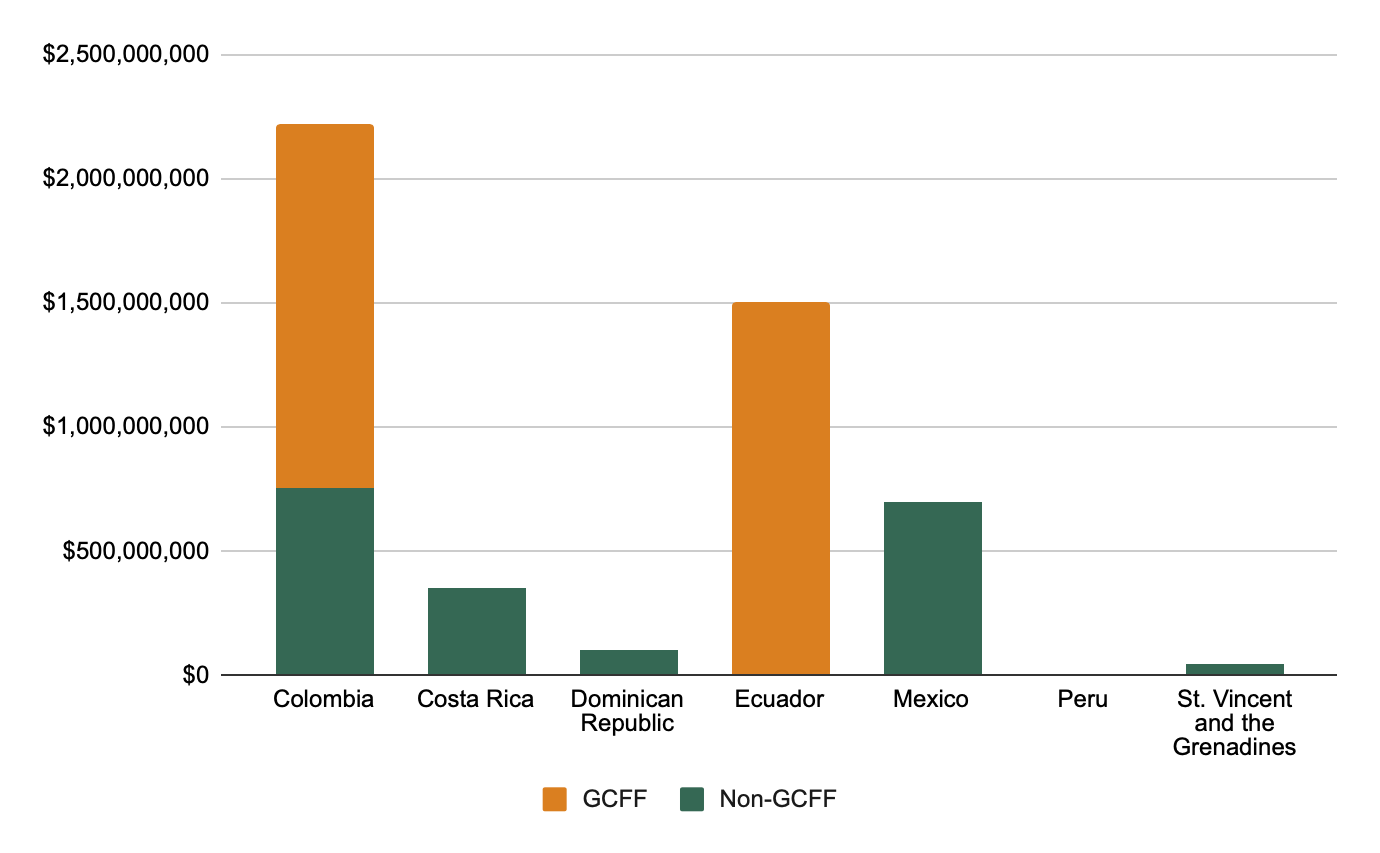
Note: Includes projects approved from May 2019 to March 2024. Totals do not include co-financing. Some of these projects might not be currently active. Source: Project list provided by the World Bank.
But despite these significant investments, the Bank’s current model leaves the majority of LAC host countries without secure and consistent access to concessional finance to support mixed-migration projects. Each migration-related operation must compete for scarce and donor-dependent resources within the Bank. Tools like the GCFF are vital and effective, but the region has yet to receive consistent levels of financing for migration and displacement-related investments. Migration is a cross-cutting development issue that shapes labor markets, national spending, social inclusion, and public service delivery—areas central to the Bank’s mission of achieving sustainable and inclusive development.
The World Bank must expand access to dedicated concessional financing for migration and displacement in middle-income countries. Doing so can help host countries implement reforms that promote regularization and economic inclusion, and expand access to public services, thus improving the overall regional response to mixed migration. Given recent global aid cuts, the World Bank is well-positioned to lead the regional response in a way that leads to long-term solutions and growth for forcibly displaced individuals and hosts alike.
Lesson 2 – Jobs, Jobs, Jobs—But Make Them Decent and Inclusive
Banga’s call for jobs is crucial—but for the Americas, inclusion means ensuring refugees and migrants can also access those jobs. For example, more than 6.8 million Venezuelan refugees and migrants are hosted in the region, including roughly 2.8 million in Colombia, making them an integral part of local labor markets and economic recovery efforts. Employment is the bridge between humanitarian response and development. Access to decent jobs allows for greater sustainability of the mixed-migrant response over time, and generates a positive economic and fiscal impact to host countries. The World Bank has been investing in economic opportunities, but much of this work has focused on de jure conditions. Once enabling policies, like the right to work, are in place, MDBs must focus on access to decent jobs in practice.
The World Bank needs to invest in programs that ensure refugees and migrants can actually secure employment and benefit from the rights granted on paper. For years, host governments have been calling for the creation of programs to integrate migrants in sectors of the economy that face labor shortages. The World Bank is already working on a pilot program called the Global Skills Partnership on Migration to bring specialized workers from abroad to work in key economic sectors that face important labor skill shortages. This program can be expanded to include the displaced population already in-country. Other MDBs are also implementing investments to foster economic opportunities for mixed-migrants in practice. For example, the Inter-American Development Bank has been investing in creating employment roadmaps for forcibly displaced individuals in several countries in the Americas.
The World Bank should provide large-scale investments that facilitate labor market integration of displaced individuals in the Americas. This includes investing in skills development and vocational training, expanding access to financial services and employment programs, and strengthening labor market systems to make them more inclusive. In LAC, as in other countries in the world, inclusive employment is the single most powerful path to stability, productivity, and social cohesion.
Lesson 3 – Collaborate Better with Humanitarian Actors
Development cannot happen in isolation from humanitarian realities. MDBs often approach migration through an economic lens, while humanitarian agencies focus on protection, rights, and service delivery. Yet the humanitarian space itself is shrinking. The recent cuts to U.S. humanitarian funding have had an immediate and disproportionate impact on the regional response to migration. Until recently, the United States had remained the primary bilateral donor supporting the LAC’s migration response. The aid cuts have been catastrophic for the region, severely disrupting migration-related programming. The inter-agency platform “Response for Venezuelans” alone is at its lowest levels of financing, as U.S. contributions plummeted from $383.7 million in 2024 to just $44 million in 2025, leaving only 8.1 percent of the 2025 appeal funded. If the humanitarian response collapses, the consequences ripple into every dimension of development. The World Bank cannot achieve inclusive growth while millions of displaced individuals remain without access to essential support and excluded from national services.
The World Bank must acknowledge these spillovers and step in to help reduce their impact. As humanitarian aid declines, essential services and protection mechanisms weaken, leaving gaps that MDBs are well positioned to fill through sustained, system-strengthening investments that build government capacity and expand national programs to include the displaced population. In particular, investments to expand forcibly displaced individuals’ access to national public services can help reduce the need for humanitarian programming. This requires not only increased financing but also genuine collaboration with humanitarian actors. The Bank should speak regularly with humanitarians to identify where needs are greatest and how its projects can complement ongoing emergency operations in coordination with host governments, as well as minimize the impact of the aid cuts to avoid a humanitarian catastrophe and to continue with the progress on integration efforts.
Across Latin America and the Caribbean, humanitarian organizations continue to face barriers engaging with the World Bank—despite existing agreements with UNHCR and IOM. Dialogue is too often limited to policy discussions, while project coordination remains sporadic. The Bank should establish systematic mechanisms for joint planning, co-implementation, and monitoring with humanitarian and refugee-led organizations. Working with humanitarian partners—not after them—is the surest way to ensure that World Bank investments reach those most at risk and turn short-term relief gaps into long-term development gains.
Lesson 4 – Prioritize an Urban Response to Migration
In the case of the Americas, displacement tends to be more urban in nature, meaning that municipalities tend to be the primary host for forcibly displaced individuals. For example, Venezuelan displacement in Peru is mainly accumulated in Lima, the nation’s capital. Thus, the effects of mixed migrant movements manifest in cities and towns, on schools, clinics, water and sanitation systems, municipal budgets, and more. While national governments remain key —especially in fostering the creation of an enabling policy environment for integration and self-reliance—municipalities face the real pressure and opportunity in practice.
Supporting and expanding the capacity of cities to host and integrate migrants is essential. While the World Bank has supported subnational projects, the focus has been national governments, mainly on policy and structural reforms. As MDB financing flows through national governments, it is harder for the World Bank to fund cities directly where de facto access to services occurs. Yet in a region where migration is mostly urban, advancing municipal-level interventions is essential for the success of the response. As Refugees International and partners argued in a recent brief Rooted in the City, “an urban-first approach is no longer optional.” Other MDBs are already implementing large-scale financing to support cities, such as the European Bank for Reconstruction and Development (EBRD)’s Municipal Resilience Refugee Response Framework (MR3) program that channeled millions in concessional finance to key municipalities in Jordan and Turkey.
To make inclusion real, the World Bank must focus on cities. The World Bank must take a deeper look at major hosting cities in the Americas, and focus its financing efforts to strengthen municipal services, local economies, and data systems to include migrants. This means channeling resources through national programs that strengthen capacity and service delivery in key municipalities with high migration flows, and investing in technical assistance to build urban management capacity. The Bank should also support national-level systems and reforms that enable access to jobs and services—such as ID, registry, and social protection frameworks—ensuring that de jure inclusion translates into de facto access at the local level.
Lesson 5 – Talk to Refugees and Migrants
Mixed-migration investments cannot succeed without the input of those they aim to serve. While the World Bank formally conducts community consultations before projects begin, these are too often procedural rather than meaningful. Forcibly displaced people rarely have the opportunity to shape priorities, implementation, or evaluation, and their representative organizations, particularly refugee-led and diaspora organizations, remain largely excluded from the Bank’s operations in Latin America and the Caribbean.
Meaningful participation is not a box to check; it is the difference between programs that work on paper and those that change lives. Listening to affected communities improves design, builds trust, and makes interventions more accountable to those they are meant to support. In the past years, the World Bank has made some progress, including acknowledging the importance of refugee perspectives in the World Development Report 2023 and conducting regular dialogues with refugee-led organizations. Yet these efforts remain uneven, particularly at the project and country levels. The Bank still lacks clear protocols and sufficient capacity to engage directly with organizations led by forcibly displaced people and diaspora networks—even though these actors have deep local knowledge, lived experience, and unique insight into protection risks and barriers to inclusion.
The World Bank should make participation of forcibly displaced populations a requirement across its migration and inclusion portfolio—treating them not as beneficiaries, but as partners. This means explicitly recognizing RLOs and diaspora organizations in project frameworks, integrating them into design and monitoring, and embedding them under the Bank’s non-discrimination and stakeholder-engagement standards. Doing so would strengthen accountability, relevance, and impact—and align perfectly with Ajay Banga’s call for a more people-centered World Bank.
The Path Forward
The Annual Meetings mark a turning point for the World Bank’s identity—from lender to leader on global inclusion. In the Americas, that vision is being tested through migration. By applying these five lessons, the Bank can redefine how development finance meets human mobility—fostering shared opportunity for prosperity.