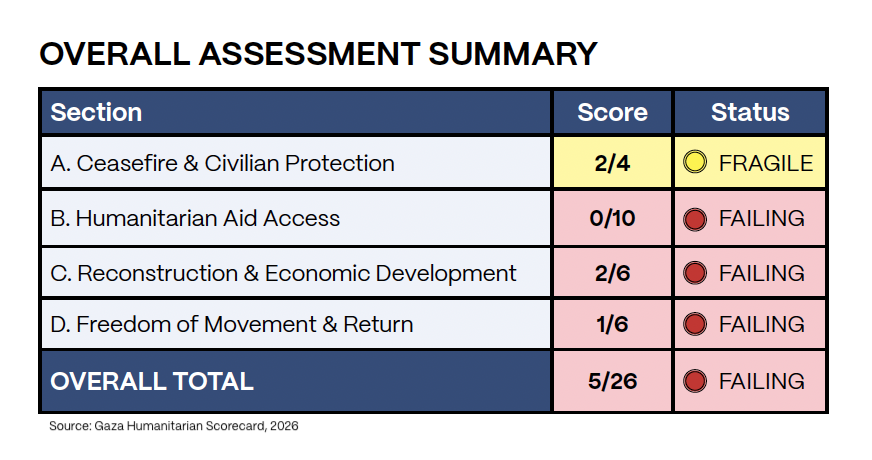
Humanitarian Scorecard: Six Months In, Gaza Ceasefire is Failing
Introduction
This scorecard evaluates the performance of the ceasefire agreement outlined in the Trump administration’s 20-point Gaza plan, as endorsed by UN Security Council Resolution 2803. It assesses progress against the plan’s stated objectives related to civilian protection, humanitarian access, reconstruction and economic development, and freedom of movement.
The ceasefire agreement was presented not simply as a mechanism to pause the fighting, but as the foundation for a fundamentally improved reality in Gaza—one that would deliver stability, humanitarian relief, and the beginnings of recovery. It received the full weight of Security Council endorsement, and the backing of a broader group of UN Member States—all of whom committed to improving the conditions for Palestinians in Gaza. The agreement itself was the result of intensive diplomacy and generated hope among policymakers and affected communities alike that it could mark a turning point.
Six months on, that hopeful promise remains largely unfulfilled. While the agreement secured the release of Israeli hostages and some Palestinian detainees and reduced the intensity of hostilities, attacks have continued and the broader framework has failed to address Gaza’s overlapping displacement and humanitarian crises in a meaningful and sustained fashion.
Key provisions intended to underpin a ceasefire—including consistent aid delivery, restoration of basic services, civilian protection, and a clear pathway toward governance and security arrangements—have been only partially implemented or have failed to materialize altogether. In the few areas in which progress has been made against the agreement’s humanitarian benchmarks, it has generally required sustained diplomatic pressure at the highest levels, particularly from the United States. That pressure, however, has not been applied consistently or at the scale needed to secure full implementation.
For civilians in Gaza, the consequences have been stark. While restrictions on commercial access have been partially relaxed, humanitarian access remains severely constrained, and markets remain volatile. Much of what enters through commercial channels is neither sufficient nor appropriate to meet large-scale humanitarian needs. As a result, most of the population is unable to access affordable, nutritious food and remains without sufficient water, sanitation, shelter, or healthcare. At least 1.7 million people remain in displacement sites, with many sheltering in deteriorating tents, lacking sanitation and repeatedly subject to flooding.
In recent weeks, conditions have deteriorated further amid regional escalation, including the U.S.-Israel-led war with Iran, with crossings repeatedly shut and medical evacuations stalled. During the first two weeks of March 2026, trucks entering Gaza declined by 80 percent, and the price of basic goods increased dramatically—fueling renewed fears of hunger.
UNSCR 2803 also established a temporary governance framework to facilitate an administrative transition in Gaza. However, the absence of a clearly defined and fully empowered governance framework has also complicated efforts to advance both immediate relief and longer-term recovery. The institutional architecture supporting Gaza under the ceasefire remains in an early and evolving stage. Bodies such as the Gaza Executive Board, the National Committee for Administrative Governance (NCAG), and related technocratic arrangements have yet to be given consistent authority or demonstrate a clear impact on conditions inside Gaza.
The ceasefire now faces a new set of difficult medium- and longer-term challenges. If it is to survive and begin to live up to its promise, an essential first step is to make meaningful progress on the humanitarian situation and the recovery of Gaza. The recommendations that follow are intended as practical measures to help do that.
Recommendations
- Take measures to enforce a definitive ceasefire across the whole of Gaza, including by setting up an independent UN-mandated mechanism to monitor, verify, and report violations of the agreement.
- Ensure an independent, transparent system is in place to process and verify humanitarian goods at Gaza’s border crossings—one that eliminates current barriers that block aid delivery—under the mandate of UN Security Council Resolution 2803.
- Ensure all the crossing points into Gaza are fully and consistently opened and facilitate the predictable flow of goods, with a minimum of 600 humanitarian aid trucks a day, and without any arbitrary limits on the range and volume of goods.
- Restore the medical corridor between Gaza and the West Bank, including East Jerusalem, so that patients can access urgent medical care within the Palestinian territory.
- Immediately restore freedom of movement for Palestinians into and out of Gaza, including for urgent medical evacuations, ensuring access is not subject to arbitrary delay, denial, or quotas.
- Lift the new Israeli restrictions for INGO registration and ensure that international organizations with Palestinian Authority registration are permitted to operate freely across Gaza and the West Bank, including sending staff and supplies into Gaza.
- Member States that endorsed the New York Declaration should now translate their political commitments into tangible, coordinated action in support of Gaza’s recovery and reconstruction.
- Ensure recovery plans do not contribute to the confinement of Palestinians or coerce further displacement and social disintegration, and instead guarantee full freedom of movement across Gaza, including access to property.
Methodology
These findings are based on the observations and experience of humanitarian organizations on the ground in Gaza and on available public data and secondary sources. The evaluation provides an independent, objective, and transparent assessment of the U.S.-led 20-point Gaza peace plan and the UN Security Council Resolution 2803, supporting it. The benchmarks assessed here are those set by the plan itself—largely input-based measures rather than conditions experienced by civilians on the ground. This differs from the standards humanitarian organizations typically apply, which measure direct impact on people. It is also worth noting that humanitarian assistance should never be conditioned on political negotiations. Under international humanitarian law, all civilians in conflict have the right to access aid, regardless of the political context. The following is an assessment (A–D categories) against the plan’s own stated benchmarks, not independent humanitarian standards.
The scorecard uses a simple three-tier grading system for each indicator: green means full or significant progress and earns 2 points, yellow means partial or inconsistent implementation and earns 1 point, and red means non-compliance, significant delays, or backtracking and earns 0 points. Each metric is connected to a particular point in the 20-point plan and UNSCR 2803 as detailed in the table below. Indicator scores based on those metrics are then added up by section and across the full scorecard. The percentage of points earned determines the overall rating: 80–100 percent is “functional,” 50–79 percent is “fragile,” and anything below 50 percent is “failing.”