Protection, Not Concession: Mexico’s Responsibility to Third Country Nationals Deported by the United States
Executive Summary
The United States is deporting thousands of third country nationals to Mexico using coercive and deceptive tactics, including enforced disappearances, in violation of U.S. law and in order to circumvent limits on who Mexico is willing to accept.
Since 2023, Mexico has accepted more than 10,000 third country nationals formally deported by the United States each year. This is exponentially more than any of the dozens of other countries (like Honduras or Ecuador) that have made recent agreements with the United States to receive vastly fewer (generally less than a few hundred) third country nationals annually. Despite the scale of removals of third country nationals from the United States to Mexico, there is no extant written agreement between the two countries detailing its terms. And, despite a 2022 ruling by Mexico’s Supreme Court, Mexico has not published guidelines for reception of third country nationals or mechanisms to grant them legal status.
When the Biden administration created lawful migration pathways to the United States through humanitarian parole programs and CBP One appointments, Mexico informally agreed to accept removals of people from seven countries (El Salvador, Guatemala, Honduras, Cuba, Haiti, Nicaragua, and Venezuela) who were arrested after crossing the U.S. border illegally rather than using lawful pathways. The Trump administration has since shut down these lawful pathways, and, as Refugees International corroborated, is removing to Mexico third country nationals who entered the United States legally and were applicants for asylum, have lived in the United States for decades, and/or have been granted protection against removal to persecution or torture in their home countries.
To facilitate this subterfuge, the U.S. Department of Homeland Security (DHS) is obscuring the identities and legal status of deportees to Mexico, including by transferring them from the interior of the country to detention at the border and by removing them to Mexico without meaningful notice, adequate screening for fear of removal, or documents. The removals leave third country nationals precarious and insecure in Mexico – or subject to repatriation by Mexican authorities to the countries they fled.
Once over the land border, the Mexican National Migration Institute (INM for its Spanish name) buses deported migrants to southern Mexico, including to Tapachula, Palenque, and Villahermosa. There, Refugees International found they have little to no meaningful access to protection or services. While some face danger in Mexico, others are at risk of refoulement when deported by Mexico to their home countries – despite having secured protection in the U.S. against such removal because of likely persecution there.
These removal and reception policies are pushing deportees into a quasi-stateless limbo – they frequently lack legal identity documents, and are unable to return to their countries of origin, deprived of their prior legal status in the United States, and unable to feasibly obtain legal status in Mexico.
For third country nationals who want to stay in Mexico, applying for asylum has become increasingly difficult due to a lack of capacity to process claims in the Mexican Commission for Refugee Assistance (or COMAR for its Spanish name) as well as a lack of legal support to navigate the system – issues deepened by recent cuts to U.S. foreign assistance. U.S. funding cuts to the UN Refugee Agency (UNHCR) has meant decreased staffing at the COMAR, leading to longer wait times for claim processing, and less funding for legal organizations providing support to asylum seekers, thereby lowering grant rates.
It is unacceptable for the United States to deport third country nationals to Mexico who have deep ties to the United States or whose fear claims have been recognized by U.S. immigration judges. The U.S. Congress and courts must stop removals to Mexico that lead to family separation, refoulement, or harm because of the lack of available services and support. However, it is likely that unjust and inhumane removals of third country nationals from the United States to Mexico will expand in 2026 to encompass people the U.S. administration has newly stripped of legal protected statuses and those coerced into agreeing to deportation due to increasingly brutal conditions of detention and threats of banishment elsewhere. In the face of this cruel reality, there are steps the Mexican government should take to mitigate the harm of these removals and provide those subject to removal more rights, support, and say in how they are treated.
Recommendations
To the U.S. Government:
- The U.S. Congress should amend the immigration law to eliminate the authority to remove people granted withholding of removal, and to mandate the creation of a process for vacating old orders of removal for people with ties to their community and who have posed no public safety risk for a certain period of time.
- DHS must abide by the court decision in DVD v. Noem and provide meaningful notice of removal to Mexico and opportunity to oppose this removal before removing to any third country nationals to Mexico. In addition, in executing removal orders to Mexico, DHS should abide by standard protocols agreed upon with Mexico’s National Migration Institute, perhaps modeled upon those for Mexican nationals, when deporting third country nationals to Mexico. These should specify that:
- Removals must occur at certain times of day, at designated places, and with support available for medical needs.
- U.S. officials must give third country nationals removed to Mexico their identity documents, property (such as wallet and phone), and immigration documents.
- The United States must provide Mexico with a list of deportees two days in advance of removal and provide Mexican authorities with accompanying personal and medical information, and immigration histories, including all countries from which they were granted withholding of removal because of likely persecution.
- The U.S. Congress should make abiding by such protocols and procedures a requirement in appropriations of funding for DHS removals.
- The U.S. Department of State PRM should reinstate funding to the UNHCR-Mexico to provide additional support to the COMAR to adjudicate asylum claims.
- The United States and Mexico should establish a priority referral system regarding third country nationals in the United States who request removal to Mexico during their removal proceedings. This procedure can be established under current U.S. law, which provides immigrants in removal proceedings an opportunity to designate their preferred destination for removal. DHS should refer these requests to the Mexican government, and the Mexican government should consider receiving them.
- DHS should provide third country nationals who are parents an opportunity to make care or travel arrangements for their children in advance of removal. The United States and Mexico should also create a mechanism to re-unify children who are left in the United States after their parents (third country nationals) are deported to Mexico.
To the Government of Mexico:
- The Mexican Foreign Ministry (SRE for its Spanish name) and the INM should refuse to accept deportees from the United States without adequate legal and immigration documentation. It should also refuse to accept third country nationals who are chronically ill (including mentally ill) or disabled unless it can make adequate provision for their care; pregnant people or families with young children; people who do not speak Spanish; and LGBTQ+ people. It should also refuse to accept deportees who have lived in the United States for more than two years or who are being deported without their U.S. relatives (unless so requested by the deportee). SRE should direct consuls not to respond to requests from ICE to accept third country nationals who have been arrested in the interior of the United States.
- The National Migration Institute (INM)’s Human Rights Directorate should implement a comprehensive screening process at the border to identify vulnerabilities and create a plan for those with identified vulnerabilities to be able to go to Mexico City to obtain specialized service. The Directorate should also give orientations to ensure deportees know about their right to seek asylum in the country as well as what services they can access in Mexico.
- Mexican authorities should take notice of U.S. immigration court withholding decisions finding that third country nationals will likely be persecuted if removed to their home country, refer these cases to the COMAR, and refrain from deporting these third country nationals to their home countries to protect against refoulement.
- The National Migration Institute should end the practice of bussing deportees to Villahermosa. Instead, upon reception, INM should give deportees a one-year humanitarian visa, and the opportunity to decide where they want to reside, including cities with employment opportunities or where they have networks that can assist with their integration.
- If busing to the south of Mexico continues, INM should provide deportees with information about shelters and services there and allow for breaks to get off the bus on the way south so as not to detain people longer than the 36-hour limit in accordance with Mexican law. If INM accepts children and families, they must be immediately transferred to child protection officials.
- The Ministry of the Interior should reallocate support in the form of seconded staff from the Coordination for Comprehensive Migration Care on the Southern Border (CAIMFS for its Spanish name) to COMAR. The Mexican Congress must approve more funding to the COMAR for personnel in the next Federal Budget Expenditures process, re-designating funds from general services to personnel costs, in line with recommendations from Mexican and international civil society organizations.
- The Mexican Foreign Ministry should establish a voluntary return agreement with Cuba to allow those who wish to return to their country of origin the ability to do so safely and with a small amount of financial assistance. This program should include screenings conducted by the UNHCR or IOM to prevent third country nationals who use this program from being returned to danger.
- The Unidad de Política Migratoria should publish statistics on the reception of third country nationals by gender, age, and nationality, and include the Ports of Entry where they are placed in INM custody, as well as the locations where they are sent within Mexico.
- The government of Mexico should make a pledge for the 2026 International Migration and Refugee Forum (IMRF) that it will better ensure humanitarian reception, including improved screening measures and individual assessments at borders and places of first arrival and ensuring that all migrants have proof of legal identity, and improved access to services, refugee status, and integration for third country nationals it accepts from the United States.
To the Inter-American Commission for Human Rights and the Office of the United Nations High Commissioner for Human Rights:
- Continue to hold hearings for civil society organizations to present the documented harms of third country deportations; issue a thematic resolution regarding the human rights of third country nationals transferred to countries that are not their own, including setting standards for treatment of vulnerable or at-risk populations; and conduct a regional investigation of U.S. rights-violating detention and transportation practices that facilitate third country removals.
Methodology
In November 2025, Refugees International traveled to Mexico City and Villahermosa, Tabasco, to assess the reception of non-Mexicans deported by the United States. In Mexico City and Villahermosa, Refugees International interviewed 15 third country nationals, spoke with representatives of several international and non-governmental organizations, met with officials from the Mexican government, and visited official government facilities for migrants and privately run shelters. This report also draws upon responses to information requests from Mexico’s National Migration Institute, a review of U.S. federal court cases involving non-Mexicans subject to removal to Mexico, as well as research conducted during a previous Refugees International trip to Villahermosa in 2024. Additionally, the research team spoke to eight organizations in Mexico regarding the impacts of U.S. aid cuts on the Mexican asylum system in 2025.
Background: Mexico’s Enforcement Collaboration with the United States Extends from Migration Deterrence to Accepting Removals
For the three decades from the 1980s through the 2010s, the United States pressured, trained, and paid Mexico to engage in immigration enforcement to prevent asylum seekers from reaching the U.S. southern border. Mexico developed enforcement strategies that were responsive to this pressure but also to domestic political sensitivities and economic concerns, concerns with the treatment of Mexican migrants, and to relations with Latin American governments.
Mexico has kept the terms of its collaboration obscure, perhaps because Mexico has collaborated more with the United States on enforcement than any other country while insisting outwardly its sovereign independence and humanitarian approach to migration. As noted in a 1987 analysis that is equally relevant today: “The high degree of government sensitivity” means “much basic information about Mexican government policies…is not available…in practice, unwritten…procedures tend to govern the treatment” of third country nationals. Further, consistently over time, central negotiations about migration between the two governments conducted by the U.S. State Department and Mexico’s ministry of foreign relations (SRE) have existed alongside local arrangements made between border sector U.S. immigration officials and their Mexican counterparts (working for INM in Mexico’s ministry of interior, or SEGOB) regarding migrants blocked from crossing the border to the United States or returned to Mexico.
In the 1980s, before it was possible to legally become a refugee under Mexican law, Mexico both hosted and deported Central Americans seeking refuge. At the time, the foreign policy of Mexico (part of the Cantadora group with Colombia, Panama, and Venezuela and as signatory of the Cartagena Declaration) was to recognize that they were fleeing violence and civil strife. But Mexico was also in the midst of an economic crisis (and high unemployment) and under pressure from the United States to limit irregular migration to the U.S. border. Just like today, UNHCR’s funding was crucial to supporting a relatively small number of registered “displaced people in refugee-like situations” in southern Mexico in the early 1980s. And U.S. collaboration was instrumental to Mexican efforts to impede much larger numbers of asylum seekers from transiting the country, including through the establishment of checkpoints along transit corridors (where extortion of migrants by officials was common) and the deportation of intercepted Central Americans. Hundreds of thousands of Central Americans, mostly Salvadorans, lived in irregular status in Mexico – and thus were vulnerable to exploitation in the informal economy and to criminals who knew the police would not help them – with no way to regularize.
Throughout the 1990s, the U.S. border was still relatively porous, and irregular crossers were mostly Mexicans who, if caught, were typically granted voluntary departure; many Central Americans claimed they were Mexican to avoid deportation to their home countries and instead return to Mexico. By the mid 2000s, even as irregular Mexican migration to the United States declined and Central American children and families increasingly fled northward, the U.S. border hardened, and the United States expanded the use of detention and expedited removal, which included bars on re-entry to the United States. Mexico also increased enforcement on buses and highways, pushing Central Americans making their way north to take dangerous freight trains, and signed repatriation agreements with El Salvador, Honduras, Nicaragua, and Guatemala, (the latter also to receive Salvadorans, Hondurans, and Nicaraguans to be transported and transferred to the borders and authorities of their own countries). In 2008, Mexico also began to repatriate Cubans who arrived in Mexico without proper documents. Most of these Cubans were transiting through Mexico to try to reach the United States by “dry foot” so that they would be paroled and eligible for adjustment of status after one year.
That same year, the United States began its Merida initiative of security assistance to Mexico that included significant funding for migration enforcement. By the mid 2010s, Central American families, Cubans, Haitians (many compelled to move on from Brazil and Chile, where they had gone after the earthquake), and extra-continental migrants were transiting Mexico in larger numbers to reach the U.S. border. Throughout the Obama administration, U.S. foreign aid to Mexico was contingent on its preventing irregular migration to the U.S. border through such efforts as Programa Frontera Sur, whereby Mexico increased check points and arrests of migrants moving north.
A marked change in U.S.-Mexico cooperation on migration policy occurred over the last decade. After historically focusing mainly on stopping migrants from reaching the United States, collaboration has now extended to Mexico accepting migrants returned or deported from the United States. From the end of 2016 through early 2020, the United States first turned back asylum seekers (Haitians, Central Americans, as well as asylum seekers from from countries in Africa and Asia) at land border ports of entry (a policy called metering) and then began “Remain in Mexico,” requiring asylum seekers (from Latin America) to wait on the Mexican side of the border for their U.S. immigration court proceedings. This “Migration Protection Protocols” (MPP) policy was complicated to administer and to coordinate with Mexico and increased cartel activity at the border. On paper, the agreement required the Mexican government to provide “jobs, healthcare, and education” to migrants while they waited, but in practice, tens of thousands of migrants slept in tents, lacked services, and were subject to rape, kidnapping, and theft while in MPP. During the COVID-19 pandemic, Mexico accepted people from El Salvador, Guatemala, and Honduras expelled by the United States, some of whom Mexico in turn expelled to Guatemala, and many of whom re-entered the United States after expulsion (sometimes numerous times). Most people expelled to Mexico were adults because Mexico limited the number of families with young children it would accept. Border Patrol and INM arranged acceptance of people expelled locally, which led DHS to laterally transfer people from one part of the border to another to facilitate increased expulsions.
Beginning in late 2022, Mexico began to accept people formally removed by the United States. When the Biden administration launched its parole programs allowing certain Cubans, Haitians, Nicaraguans, and Venezuelans (CHNV) to enter the U.S. through airports and its CBP One app to make appointments to enter at land border ports, it also began deporting to Mexico those CHNV nationals as well as Salvadorans, Hondurans, and Guatemalans who irregularly entered between ports of entry. Mexico, in turn, developed a policy of bussing these individuals to southern Mexico, particularly Tapachula and Villahermosa, and increased deportations of Central Americans from there. The Mexican government received over 19,500 people deported by the United States between May and November 2023: 1,363 Hondurans, 3,272 Guatemalans, 70 Salvadorans, 13,545 Venezuelans, 333 Cubans, 905 Nicaraguans, and 22 Haitians.
Over the past few years, most of Mexico’s bussing of migrants has been a form of alternative detention (since the law forbids prolonged detention stays) and efforts to move migrants away from the U.S.-Mexico border. There have also been a few recent efforts to use bussing in ways more attentive to the rights, interests, and well being of migrants in Mexico – but they were small, under-resourced, or poorly executed. The latter was certainly the problem with an effort by INM to disperse Haitian migrants from southern Mexico to elsewhere in the country in late 2021. More successful, if small, has been an IOM-UNHCR sponsored effort to relocate refugees and asylum seekers to cities where they can locally integrate. Finally, there was a small late 2024 program by INM to bus migrants with CBP One appointments from southern Mexico to U.S. ports of entry. All of these programs faced challenges – especially ensuring the security of the buses, well-trained staff, and sufficient financial support – but show that bussing can be done differently and suggest ways to make bussing more rights respecting and protection sensitive. Unfortunately, as discussed further below, this is not what migrant bussing in Mexico looks like today.
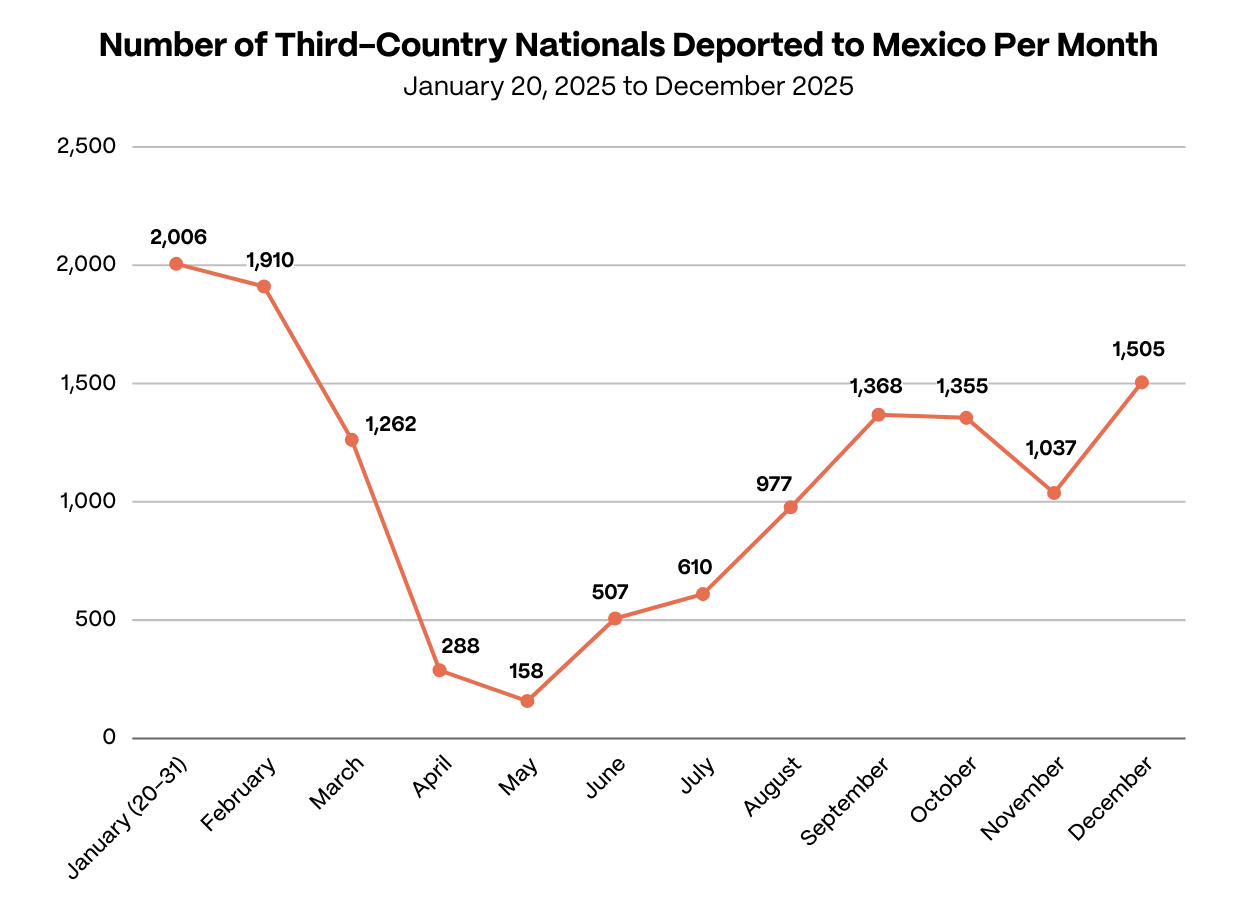
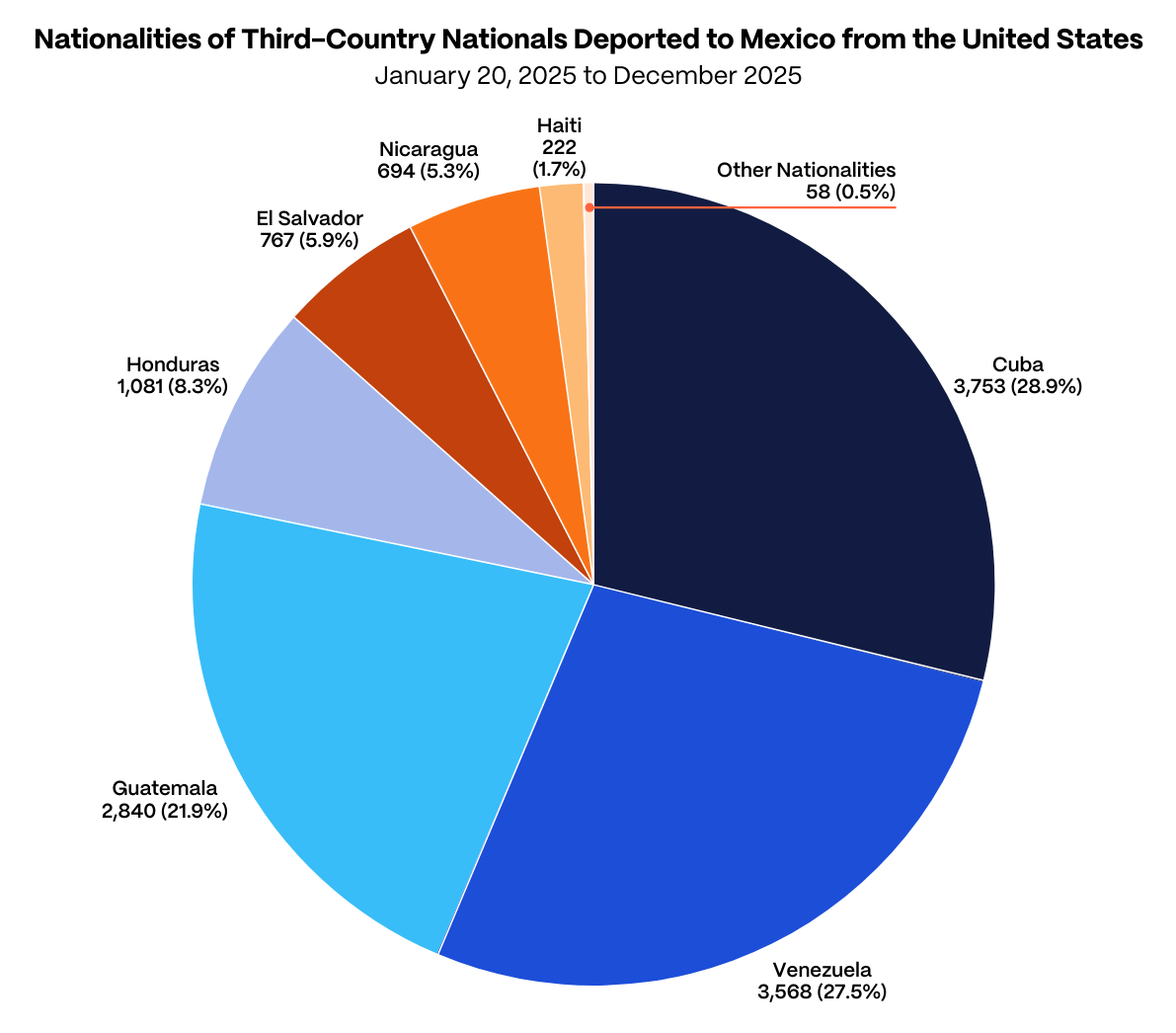
Despite the Trump administration ending the CHNV and CBP One pathways, the Mexican government has accepted deportees of the same seven nationalities from the United States in 2025. Just as in the past, the Mexican government has not been transparent about its collaboration with the United States; its Unidad de Politica Migratoria does not publish statistics on who it is agreeing to receive. According to information requests made to the INM by the organization IMUMI, between January 20, 2025, and December 31, 2025, Mexico received at least 12,983 non-Mexican nationals from the United States. A breakdown of these deportees by nationality through December 31, 2025 is 3,753 Cubans, 3,568 Venezuelans, 2,840 Guatemalans, 1,081 Hondurans, 767 El Salvadorans, 694 Nicaraguans, and 222 Haitians. Cuban deportations to Mexico dramatically increased, especially in the fall of 2025; from September to November, Cubans comprised the majority of the deportees to Mexico.
Another crucial difference is that the Trump administration has dramatically, and unilaterally, expanded the category of third country nationals it removes to Mexico – far beyond those Mexico agreed to accept under Biden. In 2023 and 2024, Mexico had only agreed to accept people at the border who recently crossed irregularly. In 2025, some of the third country nationals removed to Mexico are asylum seekers who arrived in 2023 or 2024 and were subject to the Biden administration’s regulation barring access to asylum to irregular border crossers, including people living in the interior. Many of the third country nationals deported to Mexico under Trump are long-term residents who entered the United States many years ago, often legally, and including those granted withholding or deferral of removal after proving to U.S. immigration judges that they would likely be persecuted or tortured if sent to their country of origin. Others are applicants for U visas or other humanitarian protections or people whose humanitarian statuses were abruptly terminated or who have been arrested at immigration court. Cubans removed to Mexico had been living in the United States for years with unexecuted orders of removal since the Cuban government refused to accept them; many have been arrested and detained when going for their regular check-ins with ICE. Upon being sent to Mexico, the non-Mexicans have been separated from children, spouses, or other family members who remain in the United States.
Mexico’s Handling of Third Country Nationals in 2025
Migration collaboration between the Trump and Sheinbaum administration has been markedly different than under the previous Trump administration and Sheinbaum’s predecessor Andres Manuel Lopez Obrador. Sheinbaum, noted for having a level-headed and cool approach to negotiations, has largely kept Mexico’s agreements with the Trump administration low profile. In the face of threats of increased tariffs and military intervention, the Sheinbaum administration has cooperated with the Trump administration on prosecuting cartels (including sending cartel members to the United States) but has refused to promote the use of CBP Home for “self deportation.” The Mexican government has complained to the United Nations about the mistreatment of Mexican nationals, condemned the Trump administration’s criminalization of immigrants and criticized externalization and violations of nonrefoulement. This is significant, especially because the Trump administration is using multilateral fora to undermine the global refugee protection system.
In the lead up to the 2024 U.S. presidential election and its immediate aftermath, the Sheinbam administration focused its attention on preparing for dramatic increases in deportations of Mexican nationals (including those in mixed status families) by activating its consular network in the United States and creating the Mexico te Abraza program on the Mexican side of the border. Less anticipated was the profound impact the sudden ending CBP One would have in Mexico: the stranding of an estimated 270,000 people who hoped to migrate to or seek asylum in the United States. Early in 2025, Mexico reportedly agreed “in theory” to accepting returns under a renewed Remain in Mexico program. It also agreed to continue to receive deported third country nationals of seven nationalities, but – importantly – only those apprehended after recently crossing the border rather than from the interior. In line with this policy, Mexico accepted deported third country nationals only over the land border, not by air. As discussed below, DHS’s approach to removing third country nationals to Mexico appears designed to obscure the fact that it is sidestepping these limitations.
Mexico’s foreign ministry and consular network focused for much of 2025 on addressing rights violations against Mexican immigrants: violent arrests of Mexican nationals – including those with legal immigration status – during DHS dragnets in Los Angeles and Chicago, horrific treatment of Mexican nationals in newly used immigration detention facilities marked by abusive and dangerous conditions (like holding rooms in federal buildings and “Alligator Alcatraz” in Florida), and the deportation of Mexican nationals to third countries including South Sudan and Honduras. Mexican consulates ran know-your-rights workshops, gained access to detention facilities, provided Mexican nationals with legal documents and counsel, and repatriated Mexicans deported to third countries.
In the midst of this, during the summer of 2025, SRE stopped responding to DHS requests to accept third country nationals when they were not recent border crossers; in July, consuls were instructed to ignore email requests about third country nationals from DHS.1 This lack of responsiveness is evident in habeas corpus cases brought in federal court by third country nationals detained in the United States and threatened with removal to Mexico, some of whom were ordered released because Mexico’s nonresponsiveness proved there was not a significant likelihood their removal was in the reasonably foreseeable future.2 In these cases, attorneys for DHS claim they make formal requests to the Mexican consulate regarding each individual to be returned, though it is not clear what information they provided to the Mexican government beyond nationality, such as information about criminal records or medical or mental health disorders.3
If SRE’s nonresponsiveness and professed refusal to accept certain deportees have led to favorable court rulings ordering release from detention,4 they have not stopped ICE from removing third country nationals to Mexico and INM from receiving them. DHS opted to circumvent SRE’s restrictions and deport to Mexico third country nationals living far from the border for years in the United States using a procedure — which seems to follow a July 2025 guidance on removals to third countries that was recently ruled unlawful in DVD v. Noem — described to a judge as follows:
“The petitioner will be transferred to one of the corresponding ICE field offices along the southwest border that processes third-country removals to Mexico. The petitioner will receive a Notice of Removal to Mexico 24 hours prior to his transfer to the relevant field office. The receiving ERO [(Enforcement and Removal Operations)] field office will then notify Mexico’s Instituto Nacional de Migracion (INM) of the petitioner’s upcoming removal to Mexico. Following INM’s final acceptance, he will immediately be transported to the Customs and Border Patrol corresponding port of entry for removal to Mexico.”5
Since mid-2025, ICE has also used various deceptive and coercive tactics in an effort to deport third country nationals who should not be removable to Mexico or who resist such removal. In June 2025, an ICE officer told a Salvadoran national the agency wanted to put on a bus to the border from Las Vegas to “stay quiet about his criminal record when asked by Mexican authorities and to just “go with the flow.”6 On October 1, 2025, a Cuban man who had lived in the United States for decades refused to cross the border when DHS drove him there and told him that, if he did not, “he would later be placed on a plane to Africa.”7 A Guatemalan man in the United States since 1990, when he fled Guatemala after his father had been kidnapped and killed, was told he would be sent to Alligator Alcatraz if he refused to accept removal to Mexico.
Declarations in ongoing U.S. litigation and reports from organizations that support migrants at the border reveal that ICE has reverted to informal bussing and transfers to INM (without notice to the migrants that they are being deported to Mexico and a chance to challenge such removal), or to forcing third country nationals over the border, frequently without any paperwork. On November 22, 2025, ICE deported to Mexico a transgender Honduran woman who lived in the United States for over 30 years and had been granted withholding of removal to Honduras. Immigration agents forced her and others onto a bus without telling them it was headed to Mexico, and she received no written notice that she was being removed there. ICE has transported Cubans and Guatemalans from the Fort Bliss detention center in El Paso to a border crossing in New Mexico and beaten them and threatened them with long term imprisonment unless they scale the border wall to enter Mexico. CBP officers beat a Salvadoran man and pepper sprayed a Guatemalan to force them out of vans on the Mexican side of the border. In the fall of 2025, elderly and infirm Cubans who had lived in the United States for decades and had been arrested at ICE check-ins in Florida and New York, were transported by DHS to Arizona, and summarily deported to Nogales, Mexico without any identity documents or property whatsoever. This removal of Cubans without documents may have been done to hide their age because Mexico, at least for a brief time in late 2025, officially refused to accept third country nationals over the age 60.8
ICE has continued to detain and remove, and INM to accept, third country nationals who oppose their removal to Mexico because of the violence they experienced there and despite SRE’s professed refusal to accept individuals who do not consent to removal to Mexico.9 Indeed, ICE’s removal of third country nationals to Mexico without immigration paperwork may be an effort to conceal their opposition to return to Mexico.10 Guatemalans who have been granted withholding of removal to Guatemala have been deported to Mexico despite having been extorted, raped, beaten, and kidnapped by criminal gangs or officials in Mexico, and then have to make the awful choice between staying in Mexico or returning to Guatemala (though this is impossible for those that lack documents).
ICE also continues to prolong the detention of third country nationals who have won withholding of removal to their home countries and express fear of removal to Mexico – likely in the hopes of them eventually agreeing to removal to Mexico.11
It is also important to note that there is no formal process whereby third country nationals from the seven nationalities can request, or have their lawyer request, that Mexico accept them for removal if they fear return to their home country and would prefer deportation to Mexico. In November 2025, an NGO requested that the Mexican Embassy accept a Venezuelan political dissident fearful of pending removal from the United States to Venezuela after his strong asylum application was summarily denied and he was misled by the judge to waive appeal.12 The Mexican embassy said SEGOB-INM had exclusive authority over the entry of foreign nationals into Mexico, previous referrals by SRE to SEGOB had not been accepted, and that the embassy no longer made such referrals.
Situation in Villahermosa
Once in Mexico, INM officials do not screen third country nationals nor explain to them that they can seek asylum in Mexico – even if they ask about this. Instead, INM busses the vast majority of non-Mexicans from the U.S.-Mexico border more than 2,000 miles south to Villahermosa, Tabasco or to Tapachula, Chiapas. Thus, in most cases Villahermosa is the de facto reception area for deportees, though it is not traditionally a migration destination for people on the move. The lack of a formal and comprehensive government strategy on reception of third country nationals means, in practice, that reception in Villahermosa varies by nationality. While Cubans and Venezuelans are left to fend for themselves, Guatemalans, Hondurans, and Salvadorans are typically repatriated to their home countries, including those granted protection from removal there by a U.S. judge.
Buses carrying migrants from the northern border arrive weekly in Villahermosa, the capital of Tabasco state. Prior to 2024, the few foreigners who lived in Villahermosa often worked in the city’s booming oil industry. However, with the onset of Mexico’s migrant southward busing program, the dynamics changed dramatically in a few short years. When Refugees International visited the city in the fall of 2024, most migrants in Villahermosa registered for a CBP One appointment, which would enable them to get documents from INM permitting them to travel north. In late 2025, the situation was remarkably different, as deportees from the United States are barred from re-admission to the United States and lack any pathway north.
The bus trips to Villahermosa from the northern border lack schedules to prevent nighttime drop-offs or clear protocols to ensure humane conditions on board. Deportees transferred to the custody of the INM are rapidly placed on buses for trips that can take roughly 40 hours, thus frequently violating Mexican law, which forbids detention of migrants beyond 36 hours. Food and hygiene supplies are unavailable or insufficient. The bus typically makes a stop in Mexico City on the way south, and due to intervention by civil society organizations and lawyers, deportees with identified vulnerabilities are sometimes permitted to get off the bus. Buses frequently arrive in the middle of the night to the INM detention station in Villahermosa, which is in an industrial zone of the city, far from safe lodging.
Deported Central Americans are frequently detained and returned to their home countries. Just a month before Refugees International visited southern Mexico, a Salvadoran who had won protection from deportation to El Salvador under the Convention Against Torture was shackled and bussed by ICE to Mexico without notice. Mexican authorities then transferred him to the Guatemalan border, where Guatemalan officials put him on a bus to El Salvador. Upon arrival, he was imprisoned in CECOT. In Villahermosa, INM contacts the Salvadoran consulate to arrange for repatriation of Salvadorans – even against the will of the deportees who claim they fear torture there. INM releases Cubans and Venezuelans in an industrial zone of Villahermosa, sometimes in the middle of the night, without any of their belongings – including identification, money, phones, and other key items to allow them to find their way and stay in hotels in other parts of the city. For Venezuelans, Haitians, and Nicaraguans, local organizations note that it is particularly difficult to get their documents replaced through their respective consulates in Mexico due to wait times and costs.
According to interviews with third country national deportees, they did not receive any information from the INM agents about their rights in Mexico, nor orientation for what services they could access in Villahermosa, such as shelter or health services. Deportees described having to make their way of their own accord to the one private shelter available to them called Amparito, which has capacity for about 120 people. There is one Integral Development for the Family (DIF for its Spanish name) shelter for migrant families, but the shelter was only occupied by two families when Refugees International visited. The DIF shelter has ample space and several services that it provides – including medical, psychological, social, and legal, but they are being underutilized. They could be especially used to serve third county nationals who are elderly or have specific needs and parents who are separated from children in the United States.
Mexico’s Human Mobility Model – a 2024 government strategy led by the former foreign minister to manage migration dynamics in the country – leaves several gaps in coverage for deported third country nationals. The model focuses on improving conditions in detention centers and providing specialized care for women and children migrants, including improving services in state-run shelters, which most deportees in Villahermosa cannot access. Additionally, through this model, the Mexican government set up multiservice centers created by an agreement between the Ministry of Foreign Affairs and the UN Office for Project Services, in some areas of the country designed to provide a range of health and social services to migrants in transit. Villahermosa, however, does not have one of these centers. It does have a “Mexico Embraces You” center, which is for deported Mexican nationals to be able to access myriad government services upon their return to Mexico and is a more far-reaching and robust model than the multiservice centers, but it is not open to third country nationals.
At the migrant shelter, workers noted that the majority of people who stay in the shelter are people deported from the United States. Many were taken in immigration raids in the U.S. interior and spent prolonged periods in detention under poor conditions – including in places like Alligator Alcatraz – before being transferred to a facility near the border and forced over it into Mexico.
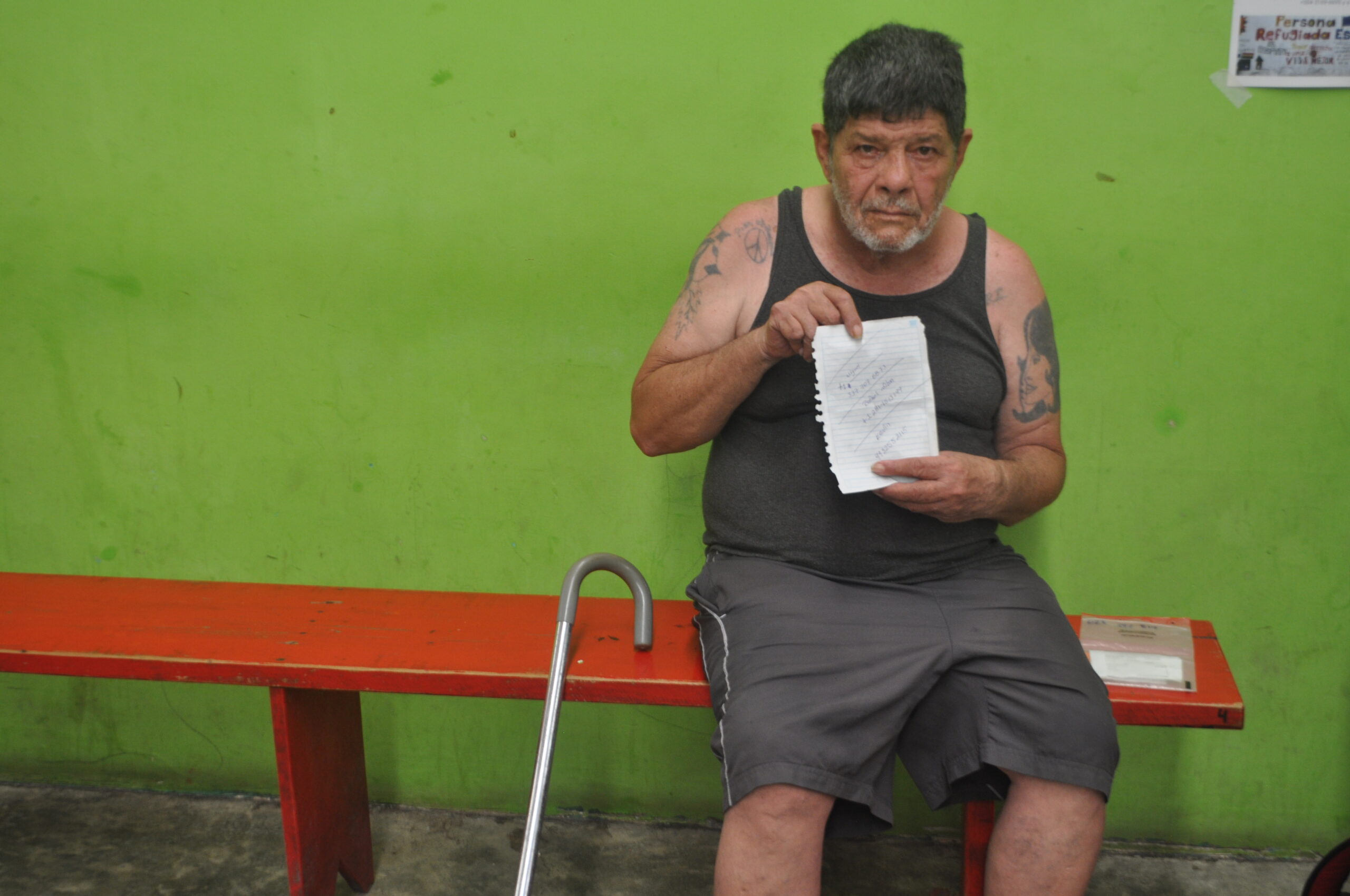
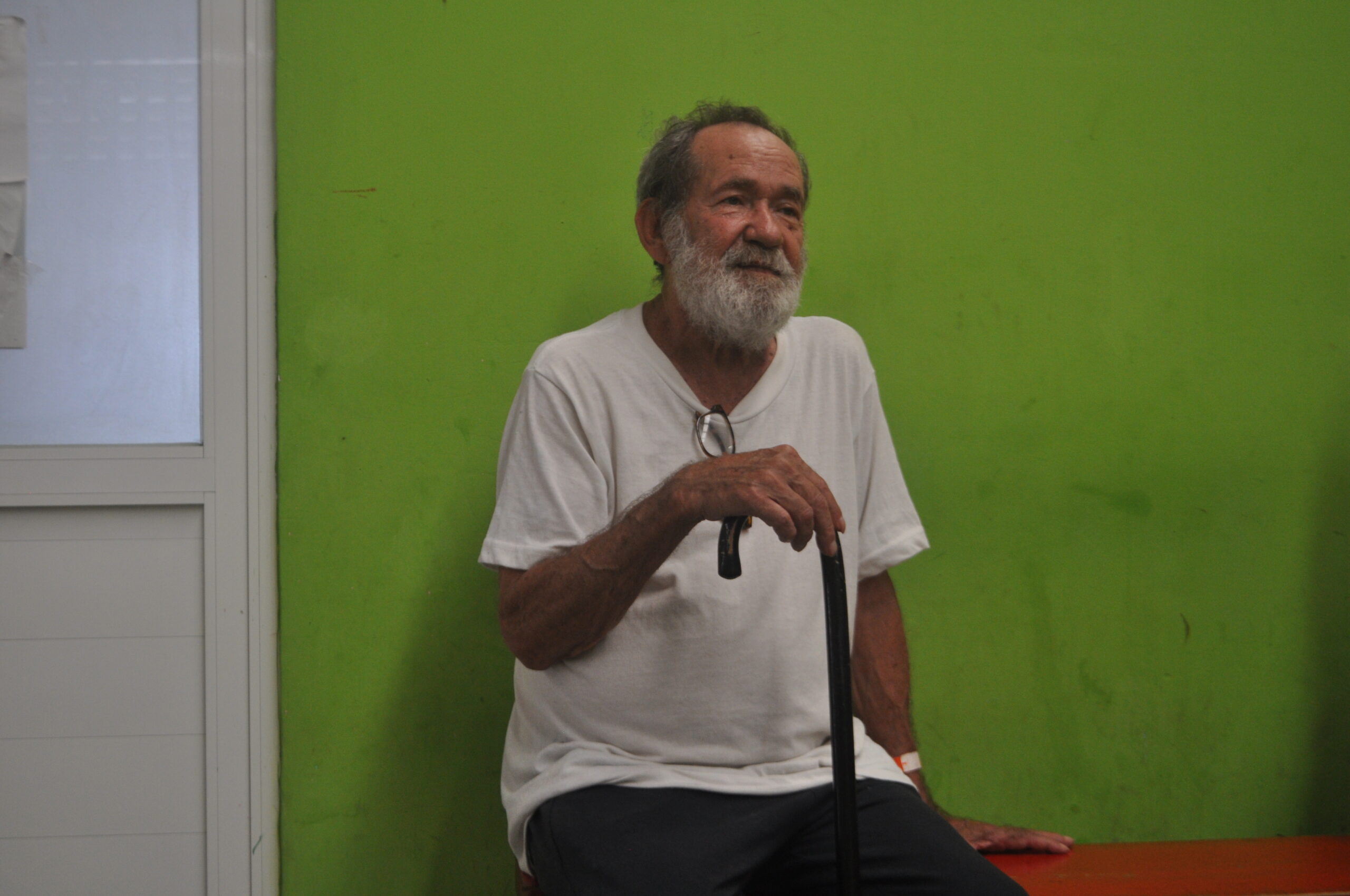
In November 2025, Refugees International observed that the majority of the Cuban deportees in the shelter were over the age of 50. Many were elderly – over the age of 60 – and infirm. Some had chronic conditions like diabetes and Alzheimer’s, and other serious mental health conditions, including one Haitian man with schizophrenia who was deported without his medication. For elderly deportees, life in Mexico is bleak and hard. Many have health conditions that prevent them from working, others will struggle to find work due to their age. Although Mexican law states that migrants should be able to access healthcare at all levels, regardless of migratory status, in practice, accessing free or specialized care can be difficult for migrants without status. Shelter workers noted that without a CURP (an identification card for citizens and residents of Mexico) elderly migrants could not access many specialized services at the hospital near the shelter. Although the shelter typically only houses migrants for a few days, they have allowed some elderly people to stay longer term, stretching their capacity.
Although several of the Cubans interviewed expressed a desire to return to Cuba rather than stay in Mexico, there are no voluntary return programs available to them, meaning staying in Mexico and applying for asylum are their most likely options. All of the people Refugees International interviewed had left Cuba in the 1980s, making their ability to claim asylum complicated given that they did not recently flee harm. The Mexican National Institute for Elderly People has services for elderly migrants such as the Pension for the Wellbeing of the Elderly (Pensión para el Bienestar de las Personas Adultas Mayores), but they have to be asylum seekers or have regular migratory status. Rare humanitarian pathways could be available to them due to health issues or other hardships, but would most likely require legal representation to obtain those pathways, something unlikely given the lack of funding for legal organizations (discussed below) and resource constraints for deportees to afford a private lawyer.
Marielitos in Mexico: The Great Unraveling of Welcome and Protection in the United States
In 1965, President Lyndon Johnson gave a speech at the Statue of Liberty to announce elimination of racial origin quotas in U.S. immigration law (which had given most immigration visas to northern and central Europeans). He also welcomed and promised refuge and support to Cubans, for whom the U.S. had an essentially open border and generous policy towards since Fidel Castro came to power. After the passage of the 1980 Refugee Act, which mandated the process of seeking asylum, Castro allowed Cubans to leave from the port of Mariel, and over 120,000 Cubans sailed for Florida. Managing this flow of migration proved challenging and elicited backlash towards asylum that persists to this day. Throughout the 1980s, U.S. diplomacy with Cuba revolved around efforts to get the Cuban government to accept removal of a small number of Marielitos with criminal records (of varying degree of severity).
In the early 1990s, when Cuban “balseros” set sail for Florida in large numbers, the Clinton administration instituted the “wet foot, dry foot” policy (summary returns to Cuba for those interdicted by the Coast Guard and entry and adjustment to permanent status in the U.S. after one year for those who reached U.S. territory) and parole pathways for Cubans (supplementing family based immigration). Cubans managed to avoid most of the harshest features of the 1996 immigration law. As mandated by the Supreme Court in 2005, Cubans with final orders of removal – frequently having committed a crime, for which they completed their sentence – were released from immigration detention and put on orders of supervision since deportation to Cuba was unlikely. Cubans were also exempted from expedited removal and instead paroled when they arrived at the border.
In 2017, President Obama ended that exemption, and, in 2023 during the Biden administration, Cubans who entered without inspection began to be ineligible to adjust to green card status under the Cuban Adjustment Act, leaving tens of thousands of recently arrived Cubans in insecure limbo. But it is only now, for the first time in sixty years, that a U.S. administration is prioritizing deporting Cubans with final orders of removal who have deep ties and lived most of their lives in the United States (a pool of over 42,000 people). The Trump administration is also doing this in the most performatively cruel way: not only sending thousands of Cubans to Mexico but also sending some Cubans to far flung places like South Sudan and perversely to be held for months at Guantanamo – only to be brought back to the United States to be detained in Mississippi and then to be ultimately deported to Cuba (experiencing the worst conditions and under the most complete U.S. economic blockade in years). Beyond trying to meet deportation quotas, in its targeting of Cubans in this way, the Trump administration seems to want to make clear to the world: the history of the United States as a nation of immigrants (who have family and businesses in the United States) and a place of refuge (including for those who flee countries the U.S. government sanctions and opposes) is over.
The U.S. government has slashed humanitarian funding to Mexico from more than U.S. $95 million in 2024 to just over $85,000 in 2025 – a 99.9 percent reduction. These funding cuts have resulted in fewer humanitarian programs for migrants in Villahermosa in 2025 than there were in 2024. Organizations noted that prior to the cuts, there were some cash-based initiatives provided by UN agencies in the city, but the program was now closed. The Norwegian Refugee Council was a lifeline for elderly migrants as they provided some assistance for lodging and had a program for victims of crimes – helping validate documents and other processes. However, their operations have been significantly scaled down in 2026. There are still some organizations providing medical support, but this is limited.
The elderly deportees to Mexico are deprived of their longstanding ties and of any country support, treated as disposable, and denied dignified life – or even death. Shelter workers noted elderly migrants stated they will “die on the street” alone. Refugees International interviewed two Cuban men in a public park who had been living on the street for weeks. Unable to return to the United States or Cuba, and unlikely to be able to start again in Mexico due to their age, health conditions, and lack of status, they were resigned to living out the rest of their days separated from family and with no place to call home.
However, not all of the people in Villahermosa are deportees from the United States – some have been sent there by the INM from other parts of Mexico, like one family that Refugees International encountered at the shelter who had been apprehended in Mexico City and sent to Villahermosa. The family, consisting of a Venezuelan father, Colombian mother, and a 16-month-old child born in Mexico with Mexican citizenship, had been living in Mexico City for over a year after the CBP appointment system had been cancelled with the intention of making a new life in Mexico. However, accessing regularization in Mexico City has been difficult for them due to their different nationalities and the cost and difficulty of getting needed and notarized documents from Colombia. Although their desire is to stay in Mexico City, they were pushed to Villahermosa where they have no ties. They had attempted to leave Villahermosa once already and were pushed back. They were hoping to leave again soon to return to their lives in Mexico City.
Leaving Villahermosa for other parts of Mexico is difficult for those without documentation in Mexico due to immigration enforcement checkpoints throughout the country that detain people for short periods of time and push them back to Villahermosa or other areas in southern Mexico. Since 2018, Mexico has expanded and militarized its immigration enforcement capacities, particularly in the interior of the country. In 2026, the budget for the INM increased by 17 percent from 2025.
Others in Villahermosa are part of the small number of people entering Mexico from the south with the intention of seeking status in Mexico. Josefina fled her country of Ghana due to persecution because of her sexual orientation and sexual abuse by her uncle. On her journey to Mexico, she was kidnapped, held for ransom and sexually abused in Nicaragua. Upon arrival in Mexico, she made her way to Villahermosa, is staying at the Amparito shelter, has applied for asylum, and suffers from insomnia. Josefina does not have access to psychological support for the abuse she suffered, nor help accessing a job with her language barriers, legal support for her asylum case, or case management to bring her two children to Mexico from Ghana if she wins.
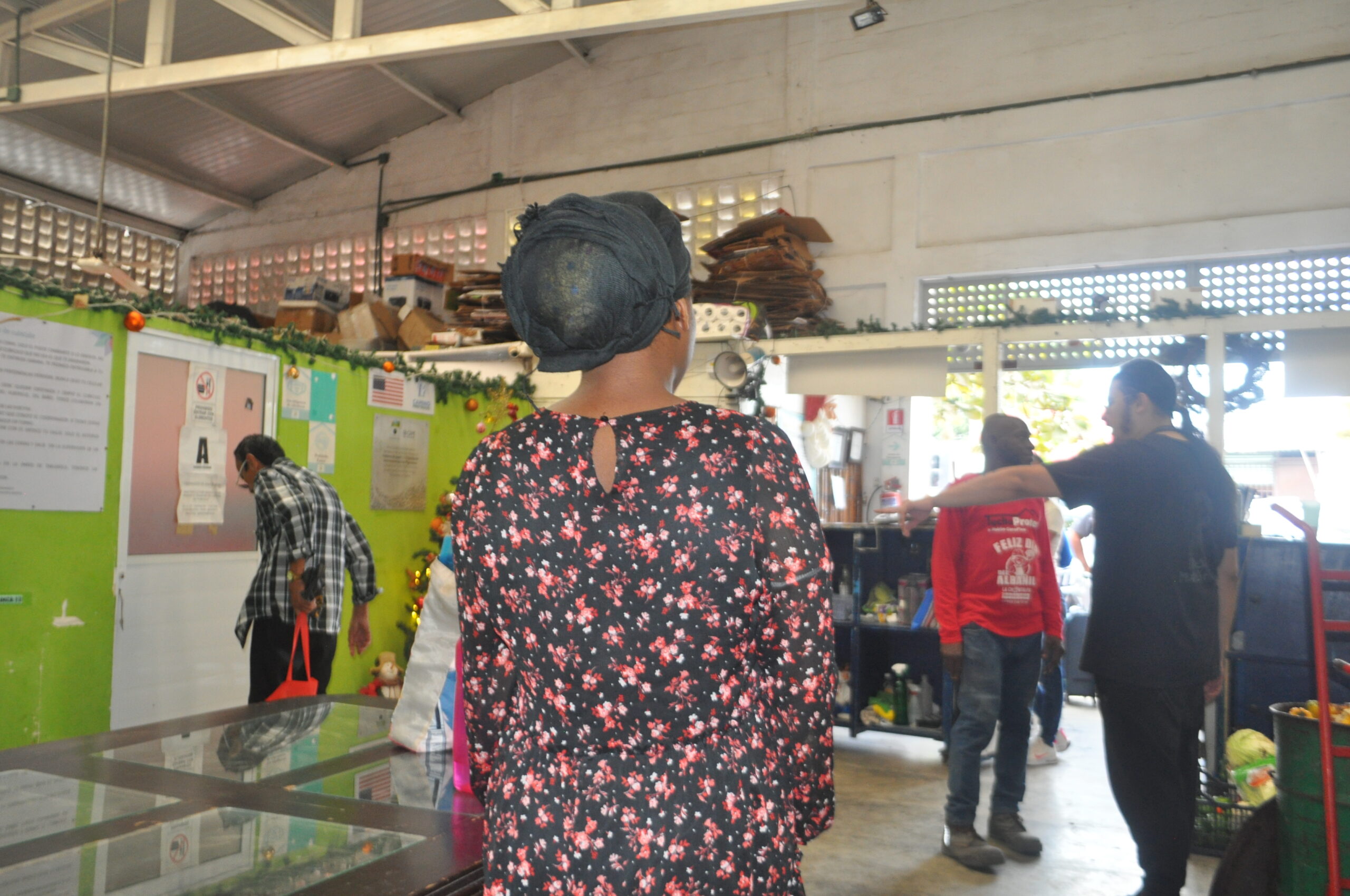
Some people are trying to make a new life in Villahermosa. Refugees International interviewed a young member of a Venezuelan family who had started selling fruits in the local market. The family had sought asylum in the United States, been deported to Mexico in late 2024, and bussed to Villahermosa by the Mexican authorities. They were working informally in the market, among other Venezuelans trying to make ends in and blend into the life of the city – since they had no other support or recourse.
Accessing Protection and the Impact of Aid Cuts on Mexican Asylum System
In 2025, the COMAR registered more than 46,000 asylum claims (according to public information requests to the COMAR), indicating that the need for third country nationals to seek asylum in 2025 is high despite a significant reduction in the number of people entering Mexico from the south – dropping about 86 percent in the first nine months of the year. This is due to the number of third country nationals being deported from the United States, the high number of people who remained in Mexico after the ending of CBP One, and the small number of people who continue to travel to Mexico as their country of destination. Some NGOs estimate that there are roughly 80,000 third country nationals stranded in Mexico at its northern and southern borders awaiting legal status.
For third country nationals who wish to remain in Mexico (whether they are migrants or deportees), asylum is one of the few options available to access a regular status as there are few other labor or humanitarian pathways available. The Mexican Commission for Refugee Assistance (or COMAR for its Spanish name) is the body responsible for receiving and processing asylum applications in the country. Since 2018, the COMAR has quadrupled its asylum processing capacity – however that capacity is now under threat.
Although the COMAR has long suffered from underfunding, there were a few key streams of financial support that allowed the agency to grow its asylum processing capacity. There are three areas of financial and in-kind support: support from the UNHCR, money appropriated by the Mexican Congress through the Federal Budget Expenditures process (PEF for its Spanish name), and seconded staff from the “Coordination for Comprehensive Migration Care on the Southern Border” (or CAIMFS for its Spanish name), a decentralized administrative body within the Ministry of the Interior.
The funding from UNHCR is especially important for the COMAR to continue to function effectively, especially that in previous years it provided more funding than the Mexican federal government. According to reports, in 2019, UNHCR provided three times the federal budget to the COMAR, allocating U.S. $3,153,546, compared to U.S. $1,041,608 provided by the Ministry of the Interior. This trend continued in 2021, with the COMAR receiving from the UNHCR double the U.S. $2,330,350 it received in federal funds, as well as in 2022, receiving U.S. $7,525,866 – roughly 2.8 times the U.S. $2,660,502 it received from the federal government. Recent studies show the UNHCR provided over 600 million pesos (roughly U.S. $35 million) to the COMAR between 2018 and 2025, making up about 60 percent of the COMAR budget on average, helping to provide technical support on refugee status determination procedures, including the application of Cartagena Declaration refugee definition for differentiated asylum procedures for more efficient asylum processing.
UNHCR has relied heavily on U.S. financing to fund its programs in Mexico and to support the Mexican government in asylum processing. In 2024, the United States contributed 86 percent of UNHCR’s, roughly $48 million of the $58 million budget for its Mexico operations. However, in 2025, UNHCR Mexico had been heavily impacted by the U.S. aid cuts, losing about 60 percent of its budget. This resulted in lay-offs of key staff, the closure of four country offices, and a reduction in some of its activities.
The cuts to UNHCR come at a time when the Mexican government is also scaling back key areas of support to refugee and migrant protection, further compounding the severe funding limitations that the agency is facing, and signifying that all three funding streams for the COMAR have been impacted.
The most notable of these impacts is the staffing for the COMAR, which is essential to the processing of asylum claims. As mentioned previously, the CAIMFS provided in-kind assistance to the COMAR through the deployment of seconded staff. These seconded staff occupied important positions in the agency, including as heads of several field offices throughout the territory and several director positions. According to humanitarian workers well connected in this area, in 2025, the Ministry of the Interior began to recall these staff, giving no indication that they will be replaced.
Additionally, while the PEF for 2026 in Mexico has a substantial increase for the COMAR budget, only 27 percent of the budget proposed is for personnel. The loss of U.S. financial support and the scaling back of Mexican government support for personnel has put COMAR in a burgeoning labor crisis. In July 2025, COMAR staff claimed they were working without a contract and without pay for weeks. They claim they have been forced to work more than 12 hours a day, including weekends, under threat of dismissal if they refuse to comply with working such hours.
In many parts of the country where there is no COMAR office – such as in Villahermosa, which only has a liaison office that does not receive asylum claims – INM is supposed to accept and refer applications from asylum seekers to the refugee agency. This has resulted in inefficiencies in the Mexican system as well as reports of INM failing to pass along referrals or lacking technical capacity to do initial asylum application intakes – despite having a larger budget. In southern Mexico, where the majority of asylum claims are filed, there are only four COMAR offices, located in the cities of Palenque, Tapachula, Oluta, and Tenosique (located in the same state as Villahermosa, but over 100 miles away).
The loss of COMAR funding and inefficiencies in the referral system with the INM have significantly increased wait times to access the asylum process – particularly in southern Mexico. In 2024, UNHCR reported that asylum cases were resolved on average in 170 days – or about five and half months. Recent reporting in 2025 has found that the wait time to receive the initial email can take between one to four months, and asylum seekers are waiting about a year for an interview.
These long wait times are affecting third country nationals’ ability to obtain any kind of documentation, which is contingent on submission of an asylum application and the COMAR deeming the claim admissible. Additionally, representatives from legal organizations also stated that the INM is failing to issue the humanitarian cards (TVRH for its Spanish acronym), the document issued to asylum seekers that provides access to work. From January to October of 2024, the INM issued only 3,457 humanitarian cards (and not all of them issued to asylum seekers), despite the fact that there were 78,000 claims made January to December of 2024 – the TVRH should be issued to all asylum seekers upon receiving proof of registering their claim.
Indeed, a UNHCR survey conducted of migrants through September 2025 found that 73 percent of those surveyed said they did not have any immigration or asylum documents to remain in Mexico. According to IOM survey data from December 2025, 80 percent of those surveyed had been in Mexico for longer than six months, 72 percent had no documentation, and 26 percent had tried to return to their country of origin unsuccessfully.
The challenges in wait times are not limited to Villahermosa, but are a country-wide issue, including in Mexico City. At the Casa Tochan shelter in Mexico City, Refugees International interviewed a man from Venezuela who fled his country because of political persecution, came to Mexico to try to get a CBP One appointment, and when it was canceled, decided to stay in the country. However, he had been in Mexico over ten months without the ability to obtain a regular status through work opportunities, so he decided to apply for asylum. While he waits for his claim to be processed, he has faced repetitive police harassment for being foreign and driving in the city. He hopes winning asylum will allow him to work formally as a driver without fear of police harassment in Mexico.
Human rights organizations also noted that there were some cases of asylum seekers who were detained in Mexico City and bussed to Villahermosa, affecting their ability to complete the asylum process as the COMAR requires signatures every ten days to prove the asylum seeker is present in the state where they made their claim.
Organizations who provide legal support, guidance through the asylum process, psychological services, and information to asylum seekers and refugees in Mexico are vital to ensuring that as many people as possible can access and navigate the asylum system, but many have lost funding. Most of these organizations depended on UNHCR funding. Between 2022 and 2025, UNHCR signed 133 partnership agreements with organizations across Mexico that covered legal, psychosocial, humanitarian assistance and support for shelters, with a total investment of 1.114 billion pesos (nearly U.S. $65 million). However, due to aid cuts, organizations are severely understaffed or resource constrained, and in some cases have closed down completely. In Villahermosa, there are only three organizations that provide legal support to asylum seekers with very limited capacity. A confidential survey of civil society organizations published in March of 2025 found that of the over 33 civil society organizations surveyed in Mexico, 58 percent were facing the threat of closure in the following six months.
One legal aid organization in Villahermosa cut their staff by half, going from five lawyers down to two. They have to be discerning about the legal support they will provide given their limited capacity, prioritizing cases by level of vulnerability. Despite the resource constraints, the need for legal support is growing – noting that the number of people who attend their informational workshops has quadrupled since the bussing began, and nearly all the people who attend have been deported from the United States.
Asylum seekers who face longer wait times to obtain an appointment and have their claims processed spend more time undocumented, and wait in poorer Mexican states like Tabasco (due to laws requiring individuals to remain in the state of asylum application), making them more vulnerable to harm. Some are unable to apply for asylum because they missed the 30-day deadline to apply due to lack of knowledge of the requirements of the Mexican system. Those without legal representation are also far less likely to have their asylum applications approved, even in cases of serious vulnerability.
One asylum seeker, Cari, a non-binary individual, fled Cuba because of persecution after state actors attacked them and their partner for seeking a same-sex marriage. In February 2025, Cari tried to cross the U.S.-Mexico border with their partner (who was taken into ICE custody and remains there to this day) and was deported to Mexico and bussed to Villahermosa. Cari applied for asylum in Mexico in mid-February, but did not receive a resolution to their case until December 2025. Despite the seriousness of the harm they experienced in Cuba, their case was denied, citing a lack of evidence. Cari had legal representation from a local organization in Villahermosa, but the organization did not have sufficient resources to handle the case. Although they have faced gender-based harassment in Villahermosa, they cannot leave because of the lack of documentation and are appealing the COMAR’s decision. “I’m just living from day to day. It’s not worth dreaming of anything,” Cari said following the denial of their claim.
If international funding remains limited, the asylum system in Mexico will become increasingly strained – particularly if the numbers of claims for 2026 continue at pace.
Conclusion
The nature of U.S.-Mexico cooperation on migration enforcement and deportation has long been sensitive and opaque; recent moves by the Trump administration are now weaponizing that opacity to abusively deport third-country migrants in defiance of U.S. law and of previous arrangements between the two countries. When speaking to a domestic audience, President Sheinbaum emphasizes Mexican independence from President Trump and its humane approach to migration. At the United Nations, Mexican officials have condemned the United States for shirking its responsibility toward refugees and its externalization policies. But in practice, the reluctance of the Mexican government to confront the United States about its tactics, more meaningfully enforce its own policies, and uphold its own legal obligations make it complicit in U.S. abuse, coercion, and unlawful removal of migrants.
Despite the sensitivities involved in its ongoing negotiations with the United States over economic and security issues, the Mexican government must be more assertive in setting the terms of its reception of third country nationals. And it must live up to its commitments to humane treatment of migrants and its human rights obligation to refugees by committing more resources to its asylum system and providing more support for the third country nationals it agrees to receive. Mexico’s actions to uphold its own sovereign policies in the context of bilateral migration cooperation will also help to meaningfully uphold the basic rights and legal protections of migrants.
Refugees International would like to thank the Instituto para las Mujeres en la Migración (IMUMI) and the Oasis De Paz Del Espiritu Santo Amparito shelter in Villahermosa for their support with this report.
Endnotes
[1] For example: Santamaria Orellana v. Baker, United States District Court, D. Maryland, Civil Action No. 25-1788-TDC, August 25, 2025.
[2] In a June 2025 sweep at a Home Depot, ICE arrested a Guatemalan man who had entered the United States in 2014 and was granted withholding of removal to Guatemala. ICE asked that Mexico accept him for deportation “under [the] CVNH program.” Five months later, ICE could not provide documentation demonstrating that Mexico agreed to accept him and the judge granted his habeas petition. Ernesto Pablo Lorenzo v.Pamela Bondi, Case No. 2:25-cv-00923 KWR-GJF, United States District Court, D. New Mexico, January 12, 2026.
Another case involved a Guatemalan woman living in Maryland who entered the U.S. decades ago and had been granted withholding of removal to Guatemala. Her application for withholding included a description of “being kidnapped and sexually assaulted by multiple men in Mexico while en route to the United States in 1999.” Edin Portela-Hernandez, Petitioner,v. Donald J. Trump, et al., Respondents.United States District Court, D. Maryland.Civil No. 25-1633-BAH, January 9, 2026.
[3] Gladys Martinez, Petitioner,v.Kristi Noem, Case No.: 25-cv-2740-BJC-BJW, United States District Court, S.D. California, Signed November 12, 2025; Jose Olea Sanchez, Petitioner(s),v. Pamela Bondi, et al., Respondent(s).CASE NO. C25-2573-KKE, United States District Court, W.D. Washington, |01/21/2026; Miguel Tan-Gutierrez, Petitioner,v.Kristi Noem, Secretary of the Department of Homeland Security, et al., Respondents.Case No.: 3:26-cv-00152-RBM-BJW, United States District Court, S.D. California, Filed 01/26/2026.
[4] Significantly, even when granting habeas petitions, judges have consistently refused to rule out removal to Mexico after due process provided (namely, a chance to prove persecution there) or to find that removals to a third country are unconstitutionally punitive.
[5] Ernest Joseph Petitioner, v. Scotty Rhoden, et al., Respondents. Case No. 3:25-cv-1579-MMH-PDB, United States District Court, M.D. Florida, Jacksonville Division, 02/02/2026
[6] L.R., Petitioner,v. Kristi Noem, et al., Respondents, Case No. 2:25-cv-02019-RFB-BNW, United States District Court, D. Nevada, Filed 01/21/2026
[7] Carlos Rios, Petitioner, v. Kristi Noem, Secretary, U.S. Department of Homeland Security;Case No.: 25-cv-2866-JES-VET, United States District Court, S.D. California, November 10, 2025.
[8] Francisco Rodriguez Romero, et al., v. Scott Ladwig, et al..United States District Court, M.D. Louisiana. Civil Action No. 25-1106-JWD-EWD, 02/06/2026
[9] Habeas petitions have been granted by federal judges because of submitted declarations indicating that the Mexican government does not accept individuals who do not willingly accept removal to Mexico. See: Victor Argenis Rea-Hernandez, Petitioner, v. Pamela Bondi, Attorney General of the United States, et al., Respondents. Case No. 2:25-cv-02609-TL, United States District Court, W.D. Washington. 02/06/2026
[10] When deportees have their immigration paperwork, they use it to prevent removal. In the face of two attempts to bring him to the border for removal in the fall of 2025, a Salvadoran showed officials a court ruling granting him withholding of removal to El Salvador ‘‘and explained that individuals from El Salvador were often ‘handed over from Mexico to Guatemala to El Salvador.’” D.A.M., Petitioner,v.Kristi Noem, United States District Court, S.D. California.Case No.: 25-CV-2657 JLS (VET), Signed January 20, 2026.
[11] Doris Elizabeth Moran, Petitioner, v. Pamela BONDI, et al., Respondents. Case No. C25-2755JLR, United States District Court, W.D. Washington, at Seattle.02/03/2026
[12] Case of Wilmer Alexander Garcia- Vellenilla, whose hearing was before Judge Theresa Scala in Tacoma immigration court, September 8, 2025.
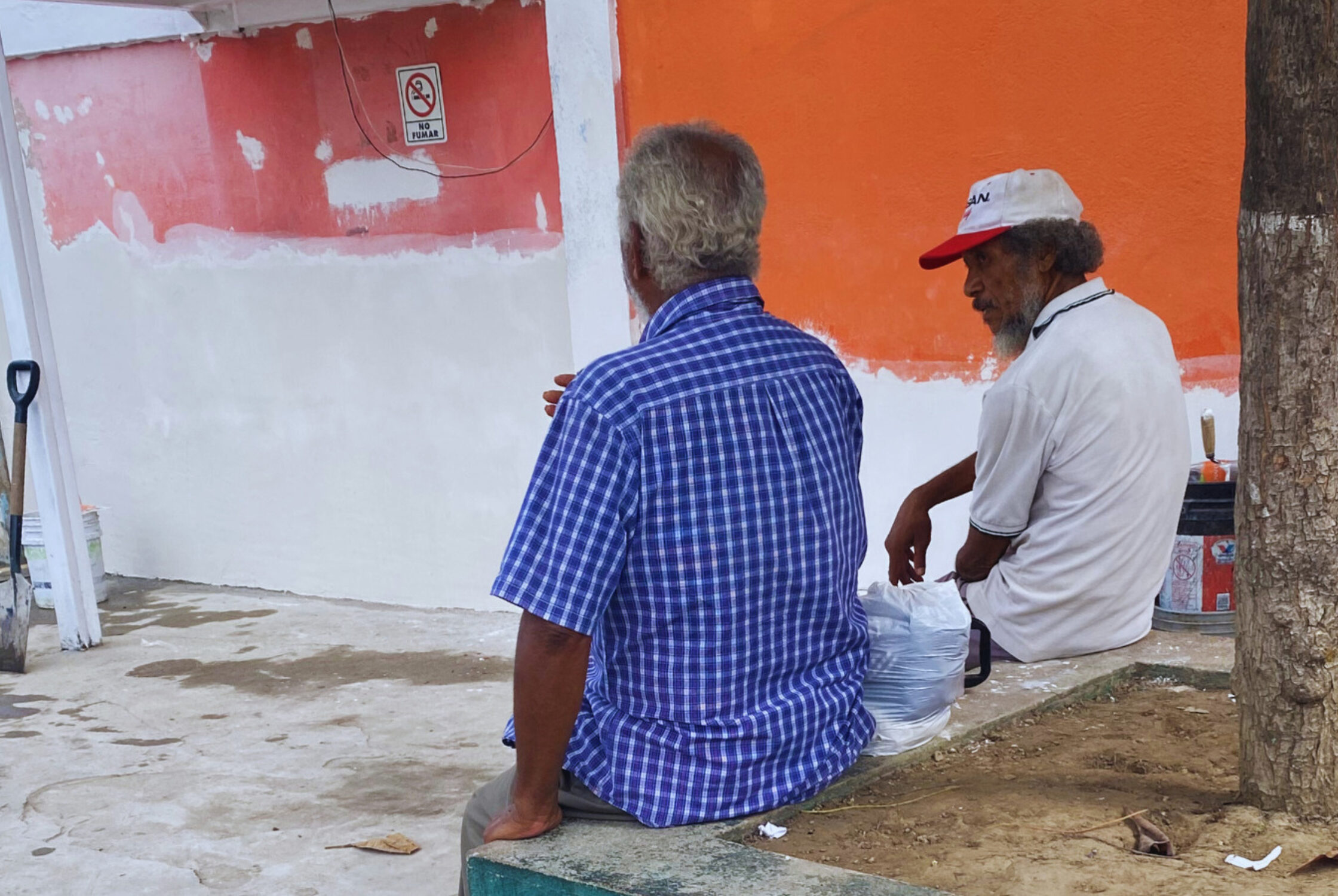
Featured Image: Two elderly Cuban deportees sit outside the Amparito Shelter in Villahermosa, Tabasco. Photo by Refugees International, November 2025.