“No One Cares About Us Anymore”: How U.S. Aid Cuts Have Intensified the Crisis for Women and Girls in Afghanistan
Executive Summary
In 2025, the Trump administration shut down the U.S. Agency for International Development (USAID) and abruptly halted most U.S. foreign aid programs. The process was poorly planned and ideologically driven, with a particular focus targeting what the administration viewed as gender-related activities. These cuts have recklessly derailed critical activities supporting the safety and well-being of women and girls around the world. The administration also stripped gender-related language from federal documents and multilateral commitments. The result has been a direct erosion of hard-won global standards on women’s protection and rights. There is arguably nowhere where the consequences are more severe than in Afghanistan, where the Trump administration canceled all aid programming – a decision that advanced and deepened the reach of the Taliban’s system of gender apartheid.
Women and girls, particularly those who are displaced, conflict-affected, or are living in humanitarian crises like Afghanistan, have borne a disproportionate share of the harm from these cuts. Their survival and protection depend heavily on services that are consistently underfunded and politically vulnerable, including gender-based violence (GBV) prevention and response, sexual and reproductive health (SRH) care, maternal health care, mental health and psychosocial support (MHPSS), and community-based protection networks. These services were among the first to be suspended or terminated following the 2025 aid implosion and remain among the least likely to be restored quickly. As services disappeared, families increasingly resorted to negative coping mechanisms, including early and forced marriage, reductions in food and health expenditures, and in some cases, transactional sex. These survival strategies deepened long-term risks for women and girls while entrenching cycles of poverty and exploitation.
These cuts have caused visible suffering across many countries. Afghanistan represents a particularly acute case in which the cuts have directly and materially harmed Afghan women and girls. It illustrates how donor retreat interacts with oppressive governance to rapidly accelerate women’s exclusion and magnify humanitarian harm. As the U.S. abruptly severed funding in early 2025, life-saving programs that had functioned as some of the last remaining entry points for women and girls into public life were forced to shut down. Hundreds of health facilities and mobile clinics suspended operations, women-led and women-serving organizations lost support, and community-based safe spaces, GBV case management, and referrals closed with little warning. The result was not only the collapse of services, but also the erosion of local protection ecosystems built over many years.
The cuts have also triggered a sharp decline in data collection and monitoring. As programs closed, routine data on maternal health, GBV incidence, protection risks, and service coverage became that much more difficult to collect. This has left humanitarian actors and policymakers increasingly blind to women’s needs just as risks escalated. This loss of gender-disaggregated data weakens accountability and obscures the true scale of harm.
The lessons of the 2021 U.S. military departure from Afghanistan are clear – and are playing out once again: abrupt disengagement carries lasting consequences. The aid cuts have now left Afghan women and girls bearing the heaviest burden. The disappearance of humanitarian assistance has pushed women and girls in Afghanistan even farther from education, employment, and health care. At the same time, they are facing heightened risks created by Taliban restrictions on movement, work, and access to services.
Indeed, Afghanistan shows how quickly important progress towards the protection and well-being of women and girls can evaporate when the U.S. dismantles institutions, abandons gender commitments, and dramatically cuts aid. In this context, aid cuts have acted as a force multiplier further undermining women’s health, safety, and survival in one of the world’s most hostile environments for women’s rights.
Key Findings
- The 2025 U.S. aid cuts disproportionately targeted women and girls globally, canceling 88 percent of maternal and child health funding, 94 percent of sexual and reproductive health funding, and nearly 80 percent of GBV prevention and response funding.
- Afghanistan has experienced some of the most severe impacts, where the total withdrawal of U.S. aid has intersected with Taliban-imposed gender apartheid resulting in widespread clinic closures, loss of protection services, and the shutdown of women-led and women-serving organizations.
- Women’s health and protection outcomes in Afghanistan have deteriorated rapidly, with reduced access to maternal and reproductive health care, GBV services, nutrition support, and psychosocial assistance.
- Afghan families are increasingly resorting to negative coping mechanisms, including early and forced marriage, reduced food intake for women and girls, and exploitative labor arrangements.
- Aid cuts have disrupted data and monitoring systems, obscuring the scale of harm to women and girls in Afghanistan.
- Afghanistan highlights how aid withdrawal combined with repressive governance quickly and severely erodes women’s health and protection.
Gender-Responsive Foreign Aid
Even before the 2025 aid cuts, the global humanitarian system was under extraordinary pressure. By late 2024, more than 123 million people worldwide were displaced by conflict, persecution, and climate shocks, with women and children comprising the majority. Crises in Afghanistan, Sudan, Ukraine, Gaza, the Horn of Africa, and eastern DRC stretched donor resources thin.
Gender-responsive services were already among the most chronically underfunded sectors.1 The 2025 U.S. aid cuts made this landscape dramatically worse. The U.S. canceled extraordinarily high shares of funding for programs designed almost entirely to benefit and protect women and girls.2 The scale, selectivity, and magnitude of these reductions make clear how little priority the current U.S. government places on the health, safety, and well-being of women and girls in humanitarian crises.
Focus on Afghanistan
Afghanistan stands apart from other humanitarian crises because the United States had a significant presence there for so long and because the state now enforces gender apartheid. Since August 2021, the Taliban have imposed a series of sweeping, nationwide restrictions on women’s and girls’ education, employment, mobility, and public participation. These measures have intensified over time, forming a coherent legal and administrative system designed to remove women from public life entirely.
Women and girls in Afghanistan are barred from secondary and higher education, prohibited from most forms of employment, restricted in their movement without a male guardian (mahram), and excluded from public spaces, governance, and civil society. In many provinces, women are no longer permitted to work even in the humanitarian and health sectors. These roles were previously carved out as exceptions under Taliban rule, but are now banned. The United Nations has characterized these policies as systematic, intentional, and cumulative, warning that they may amount to crimes under international law.
This context is critical for understanding the humanitarian impact of aid cuts. In Afghanistan, humanitarian actors are not only responding to conflict, poverty, and displacement; they are operating in an environment where women’s visibility, agency, and participation are actively criminalized. U.S.-funded programs for women and girls had served as a vital bulwark of protection and essential services. Their abrupt and total withdrawal has left Afghan women and girls less protected, increased their exposure to harm, and made it easier for the Taliban to entrench gender apartheid. While every humanitarian context is distinct, the consequences seen in Afghanistan are particularly devastating. It represents a sobering case in which donor withdrawal, layered with systematic repression, exposes the most severe negative consequences for women and girls. These are the same consequences now emerging across other aid-dependent settings.
The Pre-2025 Humanitarian Environment for Afghan Women
Prior to the 2025 aid cuts, Afghanistan was already experiencing a mass, protracted humanitarian emergency—one increasingly driven by economic hardship, repeated climate shocks, and a tightening operating environment. Over 20 million people required humanitarian assistance, including 12.4 million children. Restrictions imposed by the de facto authorities made it even harder for women and girls to access humanitarian aid and services. These constraints also complicated humanitarian delivery itself, especially where female staff are essential to reach women and girls with protection, health, and nutrition support.
The humanitarian response, meanwhile, was chronically underfunded. By the end of 2024, the UN’s 2024 humanitarian plan for Afghanistan had received well under half of what it required. With what money they did have, humanitarian actors developed adaptive strategies to sustain some services for women and girls. Flexible funding allowed organizations to negotiate access with local authorities and recategorize programming. They were also able to retain female staff where possible, and maintain some degree of critical services such as GBV response, maternal health care, and MHPSS. Humanitarian aid programs helped sustain limited, but protective space for women and girls that would not have been possible in their absence.
Women-led organizations played a particularly vital role within this ecosystem. Operating largely at the community level, they provided services that larger international actors often could not. These included safe spaces for women and girls, informal education, and survivor-centered support for victims of violence. These organizations were often the first, and sometimes only, point of contact for women facing abuse, forced marriage, or isolation. A leader of one such organization told Refugees International, “the women in the community trust us and trust our female community workers. Trust has to be built. The things women in Afghanistan face would shock you. And not just women, girls too. There is a lot of abuse and rarely anyone for these women and girls to turn to. I mean, it is not just patriarchy in Afghanistan, it is patriarchy on steroids.”
Many of these organizations relied on these small, flexible grants that allowed them to operate discreetly under Taliban scrutiny. Although U.S. funding to Afghanistan was sharply reduced after the Taliban takeover in 2021, the U.S. nonetheless remained the single largest donor between 2021 and early 2025, providing $3.83 billion or 36 percent of all international assistance during that period. While insufficient to meet Afghanistan’s growing humanitarian needs, these resources sustained a fragile ecosystem of services that continued to reach some women and girls under increasingly restrictive conditions.
The scale of this support was significant. In 2024 alone, the U.S. contributed more than 43 percent of all humanitarian contributions to Afghanistan.3 While only some U.S. funding was explicitly earmarked for women and girls, the wider humanitarian portfolio formed the backbone of service delivery systems on which women depended.
Until 2025, this U.S. funding supported a range of programs that either directly or disproportionately benefited women and girls, even as Taliban policies narrowed the space for formal women-focused work. These included maternal, neonatal, and reproductive health services delivered through Family Health Houses (community-based health clinics, often run by trained midwives and usually in rural areas) and mobile clinics; GBV prevention and response programs, MHPSS; nutrition assistance for pregnant and breastfeeding women; alternative and community-based education for girls; and women’s livelihoods programs designed to operate under Taliban-imposed constraints. Protection services alone, significantly funded by the U.S., were planned to reach more than 6 million people in 2025, a large portion of which were Afghan women and girls. Health and nutrition programs financed by U.S. contributions also helped millions of Afghan women, especially in rural areas where few other services existed.
Impact of the 2025 Aid Cuts on Programming for Afghan Women
In early 2025, this ecosystem collapsed. USAID’s Afghanistan awards were terminated, and U.S. contributions across key humanitarian sectors fell dramatically. The new U.S. administration cut off more than $560 million slated for 2025, some of which would have gone to sustaining women’s access – while limited – to health care, protection, and basic services. Programs serving women and girls across health, SRH, GBV, MHPSS, education, and livelihoods were ended abruptly without alternative donors. As a result, hundreds of clinics closed, protection services were dismantled, and women-led and women serving organizations lost their sole source of operational support. What had been a tenuous but functioning network of services, already operating under extreme constraints, was effectively dismantled.
Healthcare (Maternal, Neonatal, and Pediatric)
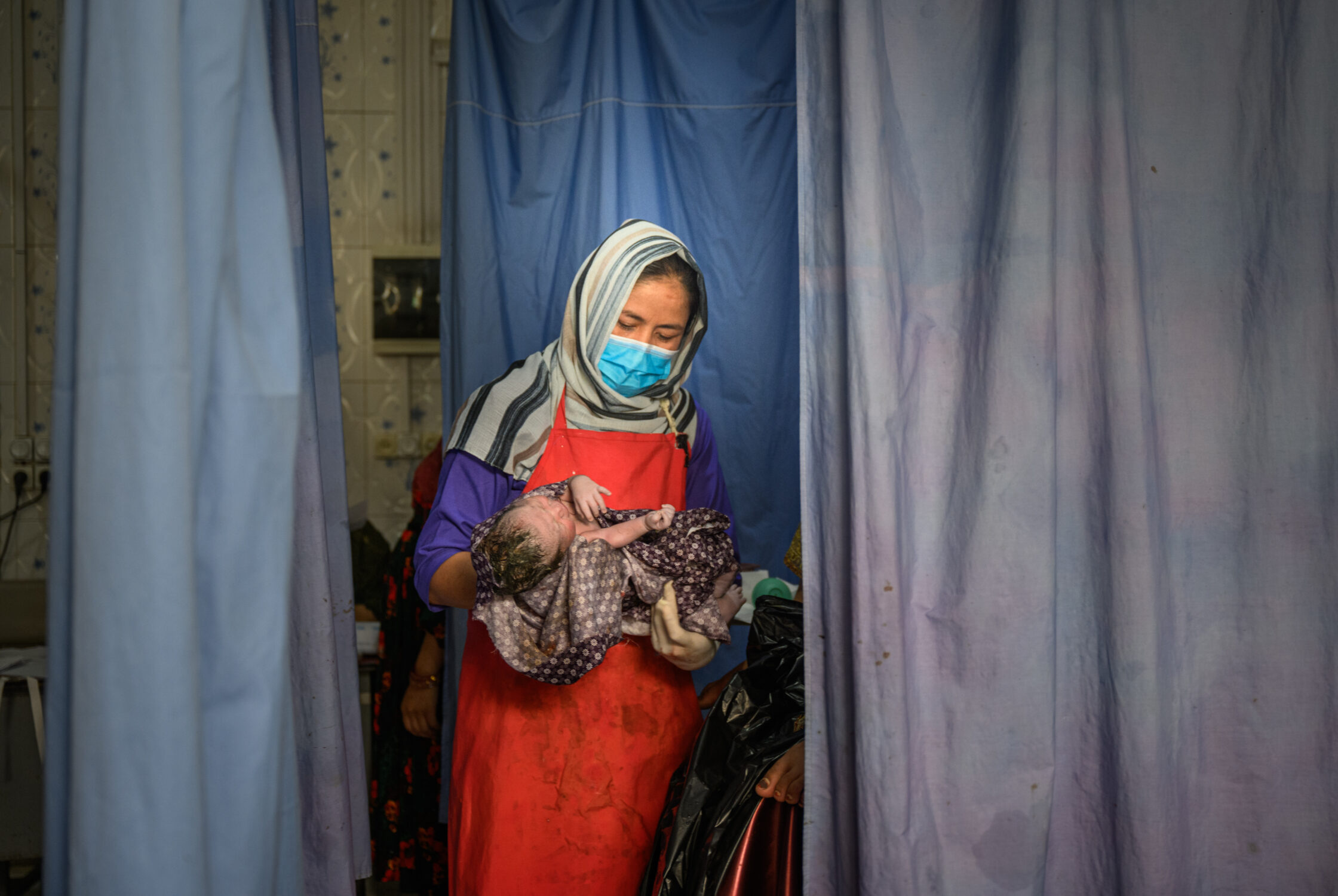
The impact of U.S. aid cuts on Afghanistan’s health system has been catastrophic. U.S. aid cuts have accelerated a systematic dismantling of women’s access to healthcare, arguably making health the single most devastating sectoral impact for Afghan women and girls. Since the termination of U.S. funding in early 2025, more than 420 health facilities across the country have closed or suspended operations. While Afghanistan has about 4,000 facilities in total, (including public hospitals, rural medical tents, mobile clinics, and Family Health Houses) the loss of so many facilities in such a short period has eliminated basic healthcare for an estimated 3 million people.
The ramifications of these cuts are already visible in worsening health outcomes. At least one hospital reported a 3 to 4 percent increase in infant mortality in the months following the aid cuts in 2025, and humanitarian actors warn that maternal and neonatal deaths are rising as women are forced to travel long distances to seek medical assistance – or forgo care entirely. Shortages of essential medicines, the suspension of mobile health teams, and the closure of community-based facilities have left pregnant women without skilled birth attendants, emergency obstetric care, or postnatal services. Trained health staff, many with years of contextual expertise, have been laid off, eroding institutional capacity that will be incredibly difficult to rebuild. Furthermore, millions of children are missing routine vaccinations that will undoubtedly lead to illness in the future.
An Afghan woman who fled to Pakistan told Refugees International:
“I speak to my family in Afghanistan as often as I can. They tell me that the situation is horrible. So much of what they rely on for their survival is just gone, finished. Especially healthcare. It is so essential, and yet, without aid from other countries, my sister who lives in a more rural area can’t get help when her child is sick. I even had a nephew die this year. I really feel like they are in a bad dream and they have lost hope. We all have.”
Taliban restrictions on women’s education and employment – including bans on women training as doctors, nurses, and midwives – are compounding these impacts. As female health workers lose their jobs due to facility closures and are prohibited from working in any other sector, the ability for Afghan women to access health care deteriorates even further.
Sexual and Reproductive Health and Family Planning
U.S. aid cuts have also precipitated a near-total collapse of sexual and reproductive health (SRH) services in Afghanistan. In early 2025, the Trump administration eliminated about 94 percent of its global funding for family planning and reproductive health. Around the same time, the Trump administration discontinued all financial support for the United Nations Population Fund (UNFPA) which is the UN agency responsible for reproductive health. These decisions resulted in the halting of programs that helped Afghan women and girls access contraception and receive reproductive health services across the country. These services are essential in a context where Afghan women have, on average, nearly five children over their lifetimes.
In Afghanistan, as early as May 2025, more than 153 Family Health Houses closed, and by September 2025 at least 1,700 female health workers had lost their jobs. Until U.S. funding was cut, humanitarian programs provided one of the few remaining pathways for several thousand female healthcare workers to continue operating under Taliban restrictions. Once that funding was withdrawn, those pathways crumbled. As a direct result of U.S. funding cuts in 2025, UNFPA was only able to support 565 midwives of the 974 planned. These closures and layoffs of local health workers has dismantled one of the last functioning systems delivering reproductive healthcare, particularly in rural and conflict-affected areas.
As of 2026, there are no new comprehensive maternal mortality estimates released for Afghanistan since UNFPA’s earlier projection that the cessation of U.S. support could result in approximately 1,200 additional maternal deaths and 109,000 unintended pregnancies between 2025 and 2028. In fact, several staff of international humanitarian agencies told Refugees International that a survey of maternal mortality in Afghanistan was underway when the funding cuts were implemented. Those same cuts terminated the survey, effectively erasing the primary means of measuring the harm they are now inflicting.
However, on-the-ground reporting indicates the maternal mortality rate may already be rising. For example, a WHO official reported a rate of about 620 deaths per 100,000 live births in early 2025, compared with the World Bank’s 2023 estimate of 521. Services critical to women’s survival including safe pregnancy care, post-rape treatment, and family planning counseling have been halted at a time when Taliban restrictions severely limit women’s mobility and access to alternate care. Adolescent girls and young women face elevated risks of death from pregnancy complications and unsafe abortions.
Protection and Gender-Based Violence (GBV)
U.S. aid cuts have also triggered a rapid deterioration of protection and GBV services in Afghanistan at a moment when risks for women and girls are skyrocketing. As funding halted, 115 GBV service provider delivery points were disrupted, affecting about 1 million women survivors who had relied on these programs for safety, psychosocial support, and referrals. Moreover, the reach of protection programming for women and girls fell precipitously. In September 2024, UNHCR provided protection services to more than 45,000 Afghan women. In May 2025 following the aid cuts, only about 24,000 women benefited from these services. This is an alarming 45 percent decrease in the number of Afghan women served, leaving huge numbers without access to even minimal support.
An Afghan woman in the U.S. who still works with a few women-led groups in Afghanistan described the situation to Refugees International, “Where are we going to refer these poor women to? Where can they get services? Between the Taliban not letting them out of their houses, and every place that used to help shutting down, there is no reason to refer GBV survivors anywhere. It is sad, but true.”
The closure of women’s shelters and safe spaces, the suspension of GBV case management, and the loss of psychosocial assistance has occurred alongside intensifying Taliban restrictions that limit women’s mobility, visibility, and access to services. As these formal protection mechanisms have disappeared, families, facing severe economic pressure and food insecurity – including returnees, single women, widows, and female-headed households – are increasingly resorting to harmful survival strategies. These include early and forced marriage and in some cases reliance on informal or exploitative labor arrangements, both of which have driven rising levels of domestic violence, exploitation, and psychological distress among women and girls.
An advocacy officer for an international organization operating throughout Afghanistan told Refugees International that “as the stressors in Afghanistan increase, and the funding for services decreases, women and girls are the first to suffer. An increase in forced marriage is especially alarming because with that comes all sorts of protection issues. But these girls have nowhere to turn, and they know that.”
For many women, accessing the few remaining services now requires traveling long distances with strict limitations on their movement including the requirement of a male chaperone (mahram), placing assistance effectively out of reach. In this context, U.S. aid cuts have not only reduced service availability, but have compounded protection risks, leaving women and girls with fewer options for safety and support.
Food Security and Nutrition
U.S. aid cuts have also sharply accelerated Afghanistan’s food security and nutrition crisis, with women, girls, and young children facing the most severe consequences. Following the termination of U.S. funding for the World Food Program (WFP) in Afghanistan, emergency food assistance was halted in May 2025. WFP now supports only about 1 million people per month, a steep drop from the 5.6 million people they served in one month in the winter of 2024.
This dramatic reduction in coverage has coincided with a rapid deterioration in food security and nutrition outcomes across Afghanistan. An estimated 17 million people are currently facing hunger, an increase of roughly 3 million compared to the same period last year. Among them, children and mothers are disproportionately affected. Approximately 3.7 million children under the age of five are now suffering from acute malnutrition, up from 3.5 million one year ago, while an estimated 1.2 million pregnant and breastfeeding women are also acutely malnourished and likely to require nutritional treatment.
The situation is expected to worsen further. By March 2026, around 9 million children—36 percent of Afghanistan’s child population—are projected to experience crisis or emergency levels of hunger (IPC Phase 3 or higher). These trends are already evident: by late 2025, millions of children were facing IPC Phase 3 or above food insecurity. At the same time, funding cuts have forced the closure of at least 305 nutrition sites, severely limiting access to care and placing pregnant women, new mothers, and infants at heightened risk of preventable illness and death.
Furthermore, female-headed households report higher levels of food insecurity and fewer options to generate income due to the Taliban’s extreme restrictions on women’s employment and mobility. As food prices rise and aid disappears, families are increasingly forced to adopt harmful survival strategies. One such common strategy is to reduce women’s food intake and prioritize the males in the family. A more extreme way to cope is for families to sell their daughters into early marriage. Thus, food insecurity is a gendered issue of survival with women and girls absorbing the greatest share of the shocks from U.S. aid cuts.
Education
U.S. aid cuts have also dealt a significant blow to possibilities of education for Afghan women and girls. In early 2025, USAID-funded education programs for Afghan girls that were operating under the radar of the Taliban, were suspended. These suspensions cut off one of the few remaining avenues for learning beyond primary school for girls.
At the same time, the American University of Afghanistan was forced to suspend its spring 2025 semester, disrupting higher education opportunities for Afghan women inside and outside the country. These programs had operated as critical alternatives in the face of Taliban bans on girls’ secondary and higher education. Their sudden closure eliminated lifelines that had enabled thousands of women and girls to continue learning despite formal prohibitions.
The long-term consequences are profound. With girls already barred from education beyond sixth grade, the withdrawal of U.S. support for informal, alternative education programs eliminates future prospects for countless women and girls. The loss of education opportunities not only undermines individual potential, but also raises broader protection concerns such as increased vulnerability to exploitation, early marriage and even lifelong poverty. U.S. aid cuts affecting the education of Afghan women and girls are therefore not just temporary setbacks. They will hasten a structural rollback of women’s rights and opportunities whose effects will reverberate for generations.
A 24-year old single woman living in Kabul with her parents told Refugees International her story:
“I am living with my parents, and I have nothing to do. I was planning to go to university before the Taliban took over, but now I have no opportunities and I am not allowed to work even if there were jobs. Life has become very difficult and money is very scarce. I was hoping that one day I would work for an American organization helping other Afghan women, but where are they? And the Taliban won’t let us do anything. Now that dream is dashed.”
Harmful Coping Mechanisms
The harms visible in all of these sectors have resulted in Afghan families, especially women and girls, resorting to negative coping strategies. Protection monitoring and humanitarian assessments over the years have indicated rising rates of forced and early marriage in Afghanistan when there is economic decline, displacement, and the absence of alternatives. Girls are married off to reduce household costs, secure dowries, or obtain perceived protection in a context where women’s independence has been systematically stripped away. This is the case now as massive aid cuts have taken effect and Taliban restrictions continue to narrow access to services, mobility, opportunities, and any remaining protective spaces.
A woman who leads gender-related work for an international organization focused on health told Refugees International:
“The situation is really dismal. I get reports from my colleagues in Afghanistan almost everyday telling me that these aid cuts have been devastating for people there. Babies dying, young girls being married off, coming in when they are thirteen and pregnant. But how can we help? We do what we can, but we have no resources. The way the U.S. keeps turning its back on Afghans is simply shocking to me.”
Afghan women are also facing heightened risks of exploitation and abuse, including transactional sex, as economic desperation has deepened. These outcomes are not incidental; they are predictable consequences of withdrawing assistance in a context where women have no legal autonomy, limited mobility, and few economic options.
Refugees International learned of one Afghan girl through a relative. Fatima (a pseudonym) is 17-years-old and grew up in Kabul with her four siblings. When she was younger, she went to school. When the Americans were still in Afghanistan, she believed she could continue her education, find work, and help support her family.
Things have been very hard for her family. With no income, difficulty affording food, and no options left, in August 2025, her family forced her to marry an older man who she did not know because they needed the money.
Now Fatima is pregnant with her first child and lives outside of the city in a more rural area with her husband who is 38. Her husband often physically abuses her the way her father did. She is scared of childbirth because she has seen her mother go through it. There is only one place she knows of for healthcare now that several have closed in her area. She hopes she will have someone to help her when it is time for her baby to come.
Women-Led Organizations
Women-led organizations have been disproportionately and systematically affected by U.S. aid cuts, with consequences across every sector outlined above. These organizations were often the primary or sole implementers of services for women and girls. Some of these services included community-based health outreach, GBV case management, psychosocial support, nutrition screening for pregnant and breastfeeding women, and informal education programs for girls.
Even before the 2025 funding freeze, many women-led groups faced significant barriers accessing international funding due to Taliban restrictions, banking constraints, and simply not being on the radar of large international donors. Most of the U.S. funding reached these organizations by going through UN agencies first, being disbursed as cash, using hawala networks, or by being offered as in-kind donations. Given the difficulty operating in Afghanistan even before the aid cuts, U.S. support to women-led Afghan organizations depended on these forms of intermediary funding, informal financial systems, and low-visibility partnerships. Few of the women-led organizations had diversified funding streams, so when the U.S. cut aid, many of these organizations were out of options.
As funding has dried up or abruptly stopped, many of these organizations have dissolved, gone underground, or ceased operations entirely. As one Afghan leader explained, “We need money to do our work, but you can’t find any money here. I have risked my life trying to help other women in Afghanistan, and I would keep risking my life over and over again, but I can’t do anything if there is no funding. We are no longer in the news, so no one cares about us anymore.”
The loss of women-led organizations has had outsized impacts across sectors and has magnified the harms documented in health, protection, food security, and education. In Afghanistan, the closure or suspension of women-run NGOs and community-based groups has led to the loss of trusted entry points for maternal and reproductive health care, the collapse of gender-based violence referral pathways, and the disappearance of safe spaces where women could seek counseling, legal support, and emergency assistance. Across the country, women previously relied on female-led outreach teams to access mobile clinics, food distributions, and girls’ education initiatives. As these organizations have been forced to shut down in most of Afghanistan’s 34 provinces including Bamiyan, Logar, Kunar, Nangarhar, women and girls face heightened isolation, reduced access to lifesaving services, and increased exposure to exploitation and abuse. The result has not merely been a reduction in services, but the dismantling of any gender-responsive humanitarian infrastructure in Afghanistan.
The Need for U.S. Action
Given the backdrop of accelerating gender apartheid in Afghanistan, the total cuts in U.S. aid are helping to advance the Taliban’s anti-women agenda. The ban on aid to Afghanistan must be lifted so that critical lifelines for women can be restored. This includes restoring and protecting funding for maternal, neonatal, pediatric, and emergency obstetric care; reopening Family Health Houses, mobile health teams, and community-based clinics; and ensuring humanitarian waivers explicitly cover maternal, reproductive, and post-rape medical services without administrative delays. The U.S. should work with UN agencies and trusted partners to retain female health workers through salary support and flexible delivery models that function under Taliban restrictions, while avoiding additional funding withdrawals that destabilize multilateral health systems. Restored humanitarian assistance should preserve core protection services, including referral pathways, emergency case management, psychosocial support, and safe spaces. These services should be embedded within broader health, nutrition, and food assistance programs, with priority given to women-led and community-based organizations best positioned to reach women under mobility and access constraints.
In parallel, U.S. policy makers should prioritize nutrition interventions for pregnant and breastfeeding women, including treatment for acute malnutrition, and support improved monitoring of food insecurity to ensure women-headed households and other high-risk populations are identified and reached through gender-responsive assistance models. Education should likewise be treated as a core protection concern rather than a standalone development issue. At a minimum, the U.S. should avoid actions that further destabilize informal, community-based, or remote learning initiatives, and prioritize low-profile education models such as home-based and distance learning where funding is available. For Afghan women already enrolled in higher education abroad, the U.S. should work with partner governments to prevent forced returns, expand temporary protection, and support scholarships. Without these combined mitigating measures, preventable maternal deaths, unsafe pregnancies, worsening malnutrition, and long-term protection risks for women and girls will continue to deepen Afghanistan’s humanitarian crisis.
Conclusion
The situation in Afghanistan is set to deteriorate further in 2026. Therefore, the U.S. needs to do what it can to avoid the worst consequences for the millions of Afghans who are being negatively affected. In 2026, an estimated 21.9 million people will require humanitarian assistance with women and girls comprising more than 10.7 million of those in need. Yet at this point, the U.S. has committed no humanitarian funding at all to Afghanistan. This complete withdrawal of support reflects a broader application of responsibility. Having already witnessed the consequences of a poorly planned military exit, the U.S. should not compound that failure by abandoning Afghanistan through an equally abrupt humanitarian withdrawal. After 20 years of war and occupation, it is unconscionable for the U.S. to now provide no humanitarian funding at all to Afghanistan, effectively turning its back on the civilian consequences of its own intervention. Sustained, adequately funded humanitarian support is a moral imperative, especially for women and girls.
Afghanistan is exceptional, but it is not isolated. It demonstrates how donor retreat interacts with draconian governance to accelerate women’s exclusion and deepen humanitarian harm. It shows how quickly the work to make humanitarian systems more gender-sensitive can evaporate when funding and political commitment are withdrawn. A key lesson from Afghanistan is that women’s health and protection are among the first casualties of aid cuts and gender backsliding everywhere. When the U.S. dismantles institutions, abandons gender commitments, and withdraws funding impetuously and drastically as it has done in 2025, women and girls bear the brunt of the harmful consequences.
Recommendations:
To the U.S. Executive Branch:
- Lift the ban on U.S. assistance to Afghanistan to prevent further loss of life and avoid the further entrenchment of disproportionate harms being borne by women and girls.
- Restore and protect women-centered, lifesaving aid which includes maternal, neonatal, and pediatric health services, prioritizing Family Health Houses, mobile health teams, immunizations, and emergency obstetric care.
- Expand humanitarian exemptions to explicitly cover maternal and reproductive health, nutrition, and GBV programs.
- Retain female health workers through salary support and flexible service models compatible with Taliban restrictions.
To the U.S. Congress:
- Appropriate sufficient funding for life-saving humanitarian assistance in Afghanistan including programs focused on maternal and child health, nutrition, and protection for women and girls.
- Use oversight to scrutinize the freezing of contracts, waivers, and terminations, and determine how the discontinuation of funding to Afghanistan is harming Afghan women and girls.
- Require regular reporting on health facility closures, maternal and infant mortality trends, food insecurity, and GBV risks resulting from U.S. policy decisions.
To UN Agencies and International NGOs:
- Prioritize the continuity of life-saving, gender-responsive services across health, nutrition, protection, and education.
- Strengthen gender-responsive needs assessments and monitoring to ensure women’s and girls’ needs are reflected in funding appeals.
- Preserve core services for women and girls by integrating protection, GBV risk mitigation, and gender-responsive nutrition initiatives into health and food security programs.
- Build up intermediary funding mechanisms dedicated to quickly sending small, flexible grants to women-led organizations so they can continue operating, while international partners hold the funding and manage the risk.
Endnotes
[1] In 2022, programs to prevent and respond to violence against women and girls received only 0.2 percent of global foreign aid, even as rates of sexual violence rose globally. In fiscal year 2024, just 12.1 percent of USAID funding was disbursed directly to local partners. Women-led organizations, despite being recognized as critical first responders, received only a fraction of that.
[2] As part of the aid cuts in 2025, the U.S.—cutting 88 percent of maternal and child health funding (about $740 million), 94 percent of sexual and reproductive health and family planning funding (roughly $315 million), and nearly 80 percent of humanitarian support for gender-based violence prevention and response (at least $114 million).
[3] This included approximately $385 million for food security, $32 million for health, $71 million for nutrition, and more than $30 million for protection, with approximately $17 million of that dedicated to GBV prevention and response and child protection programs.
Featured Image: A midwife holds a newborn at a hospital in Ghazni, Afghanistan, in one of the few maternity units left in the province in the wake of U.S. aid cuts. (Photo by Elise Blanchard/Getty Images)